Today's
EarthStation1.com 15% (Or More!) Off Commemorative Memorial Title:
Making Sense Of The Sixties TV Series DVD, Video Download, USB
Drive
Today, August 17, 2026
August 17: Baby Boomers Recognition Day:
-- A day that honors a generation of people who are among the
largest, if not the richest, in the country. Baby Boomers (1946 -
1964), also known as "The Sixties Generation" or simply
"Boomers", refers to the demographic born after The
Silent Generation (1928 - 1945) and before Generation X (1965 -
1980). This generation, which is now between the ages of 57 and
75, represents those born during the post-World War II baby boom.
In 1946, almost three million infants were born in the United
States, breaking the country's birth record. Although the phrase
has been used beyond the United States, its cultural connotations
and demographic context differ. Baby Boomers Recognition Day was
initially held in June. It was moved to August when boomers across
the country agreed that it clashed with father's day celebrations.
Boomers have fond memories of those early years when they rocked
the world. They were named for the increasing birth rate that
occurred following the end of World War II. The baby boom during
that time was caused by the economic upswing and a desire for
normalcy following the war and the Great Depression. Theirs was an
eventful era; early baby boomers were prime instigators of
cultural movements like Woodstock and the Summer of Love. During
an era of significant societal change, they were also powerful
forces to be reckoned with. They had to deal with topics such as
the Vietnam War and came off as mostly liberal; early baby boomers
were more liberal than their later counterparts. The baby boomers
lived through a number of significant events. They were the first
generation to have Barbie dolls and to receive polio
immunizations. The first manned space mission and the first lunar
landing were both witnessed by boomers. During the boomers' reign,
Martin Luther King, John F. Kennedy, and Bobby Kennedy were all
assassinated. Furthermore, in 1969, 400,000 people gathered on the
fringes of Woodstock, New York for a three-day music event from
August 15 to 18. The event provided the boomers with the ideal
opportunity to convey their message of love and peace while also
enjoying some amazing music. That movement has now become a
defining milestone for the Baby Boomer generation. On Sale Until
Midnight Tonight PT!
https://store.earthstation1.com/making-sense-of-the-sixties-tv-documentary-series-6-hour-episode6.html
Today's
EarthStation1.com 15% (Or More!) Off Commemorative Memorial Title:
The Fabulous Sixties with Peter Jennings TV Docuseries MP4 Or DVD
Set
Today, August 17, 2026
August 17, 1969: Counterculture Of The
1960s: The Hippie Movement: Counterculture Festivals: Music
Festivals: Pop Festivals: Rock Festivals: The Woodstock Music And
Art Fair (The Woodstock Festival, Woodstock): -- The Woodstock
Music And Art Fair concludes its three days in upstate New York, a
music festival featuring some of the top rock musicians of the era
which attracted an audience of more than 400,000. Scheduled for
August 15-17 on a dairy farm in the Catskill Mountains of southern
New York State, northwest of New York City, it ran over to Monday,
August 18. Billed as "An Aquarian Exposition: 3 Days of Peace
and Music", it was held at Max Yasgur's 600-acre (240 ha;
0.94 sq mi) dairy farm near the hamlet of White Lake in the town
of Bethel. Located in Sullivan County, Bethel is 43 miles (70 km)
southwest of the town of Woodstock in adjoining Ulster County.
During the sometimes rainy weekend, 32 acts performed outdoors. It
is widely regarded as a pivotal moment in popular music history,
as well as the definitive nexus for the larger counterculture
generation. The event was captured in the Academy Award-winning
1970 documentary movie Woodstock, an accompanying soundtrack
album, and Joni Mitchell's song "Woodstock", which
commemorated the event and became a major hit for both Crosby,
Stills, Nash and Young and Matthews Southern Comfort. Joni
Mitchell said, "Woodstock was a spark of beauty" where
half-a-million kids "saw that they were part of a greater
organism". In 2017, the festival site was listed on the
National Register of Historic Places. On Sale Until Midnight
Tonight PT!
https://store.earthstation1.com/decades-the-1960s-dvd-set-peter-jennings-tv-series-3-19603.html
Today's
EarthStation1.com 15% (Or More!) Off Commemorative Memorial Title:
Super Sense Animal Perception/Plant Adaptation TV Series DVD, MP4,
USB
Today, August 17, 2026
August 17: National Black Cat
Appreciation Day: -- Not to be confused with National Black Cat
Day on October 27th, National Black Cat Appreciation Day on August
17th aims to dispel all myths surrounding black cats.
Superstitions aside, cats are simply adorable, even black ones.
Once, black cats were considered companions of witches. If the
black cat crossed your path it would bring bad luck. However,
other cultures saw black cats in a more favorable light and saw
them as a good omen. These feline creatures in their sleek, black
coats may carry an air of mystery. However, most cats do. Along
with that, their ability to find mischief or to avoid you equals
that of tabbys, cinnamons, gingers, calicos, whites or grays.
However, one black cat fact that holds true is they are less
likely to be adopted. Just like black dogs, this variety of cat
gets shunned at shelters. Despite this, black cats still respond
to love and attention no differently than other felines. So, let a
black cat cross your path. They aren't witches. More than likely,
adopting a black cat will help keep the mouse population down
around the place. Expect the number of cuddles in your life to
increase, too! To observe Black Cat Appreciation Day, consider
adopting a black cat. Take photos of your black cat, too! Support
your local shelters and volunteer. You can groom a black cat (or
any cat for that matter), give him cuddles, and maybe even take
one home. Overcome your fears and use #BlackCatAppreciationDay
while sharing your new-found love for those black cats on social
media. On Sale Until Midnight Tonight PT!
https://store.earthstation1.com/super-sense--animal-perception-tv-series-dvd-mp4-download-usb-driv4.html
Today's
EarthStation1.com 15% (Or More!) Off Commemorative Memorial Title:
Counterculture Films Collection DVD, Video Download, USB Flash
Drive
Today, August 17, 2026
August 17: National Thrift Shop Day: --
Today is all about supporting local thrift shops and raising
awareness for charitable organizations. Thrift shops aim to help
those most vulnerable in communities and give back to the needy.
Known by a myriad of other names, thrift shops are also referred
to as consignment stores, second-hand stores, resale shops, and
hospice shops. Volunteers willing to help out usually work at the
shops, often sorting through donated items people drop off. These
used pieces are then sold to the public, providing those in need a
convenient service at an affordable price! Before thrift shopping
became common, people usually liked to repurpose their clothes.
During the eighteenth century, many new ways of using old items
were created. If someone's clothing became worn, they'd give it to
a younger sibling as a hand-me-down and made into clothes for
them. Even after the siblings tired of this, the material would be
recycled as furniture stuffing. People also often sold their items
if they needed the money, but the thrift shop concept had not yet
been created. By the late nineteenth century, the United States
experienced a massive cultural shift. The Industrial Revolution
increased the production of clothes and goods, while the pursuit
of the American dream led to heightened immigration. Many moved to
urban areas, causing the process of buying new clothes and
disposing of old ones to quicken. Pawnshops and scrap yards arose
to provide for this need, but there was an unfavorable opinion
surrounding clothes that were once owned by a stranger, as it
indicated a lower social status. Christian ministries needed
funding for their outreach programs, and religious affiliation
groups such as the Salvation Army and Goodwill changed the
narrative. In 1897, the Salvation Army launched the "salvage
brigade." Residents would go around the neighborhood asking
for used clothes. In return, they'd receive food and lodging.
Then, In Boston 1902, a Methodist minister created Goodwill that
hired poor and disabled people to collect goods and make necessary
repairs to them. These shops provided immigrants with a place to
find clothes, assimilating Christian values with social service
activities. Thrift shops reflected the department stores of the
time in the 1920s. Initial impressions began to change after
thrift shops stopped being known as "junk shops." By
1935, there were nearly 100 Goodwill stores nationwide and they
were useful during hard times the nation faced. The Great
Depression and World War II made thrift shops more viable as a
more affordable option to full-priced stores. People warmed up to
the idea of thrift shops as a way to find vintage items and niche
goods, and ever since, the thrift shop has steadily shed its
negative image. On Sale Until Midnight Tonight PT!
https://store.earthstation1.com/counterculture-film-collection-dual-layer-dvd.html
Today's
EarthStation1.com 15% (Or More!) Off Commemorative Memorial Title:
United Nations Documentaries Set DVD MP4 Download USB Drive
Today, August 17, 2026
August 17: National Nonprofit Day: --
Recognizes nonprofit organizations' ongoing efforts to serve the
local community. If you've ever volunteered, you're well aware of
the significance of these charitable organizations. Nonprofits
throughout the country work to promote awareness and offer
assistance to individuals who otherwise would not be able to
afford it. Their activities contribute to the shaping of our
society and provide hope for a brighter future. We all contribute
in some manner, whether it's by volunteering, giving, or just
spreading the word about a nonprofit. In 2017, Americans donated
more than 400B USD to a variety of charity organizations. What a
great example of teamwork! The Tariff Act was signed into law on
August 17, 1894. It provided exclusions from the federal income
tax levied on corporations for charitable organizations and
charities. Despite various changes over the years, the exemptions
for N.G.O.s remain stable and continue to expedite charity
organizations' operations. Incentives like this one make the
nonprofit environment more accessible to new organizations.
Sherita J. Herring, an author, and respected speaker launched
National Nonprofit Day. Its goal was to educate and empower
everyone to be the change we want to see in the world. Recognizing
that there are individuals in our midst that require assistance is
the first step toward positively changing our society. Charitable
organizations have been strong warriors in the struggle to close
the wealth divide. They give a forum for people to reach out to
the poor, either directly or through donations. According to the
National Center for Charitable Statistics, there are 1.5 million
registered organizations in the United States. These organizations
play a vital role in community development by offering services
such as food banks, affordable housing, medical care, legal
counsel, and education. Another important contribution of the
nonprofit sector is after-school activities; the daycare centers
they provide are vital assets to these communities. The nonprofit
sector is a significant contributor to the national economy,
employing professionals such as lawyers, engineers, nurses.
Following the recession in 2012, the nonprofit sector contributed
up to 887.3B USD, amounting to 5.4% of the nation's Gross Domestic
Product. On Sale Until Midnight Tonight PT!
https://store.earthstation1.com/united-nations-documentaries-set-dvd-mp4-download-usb-driv4.html
Today's
EarthStation1.com 15% (Or More!) Off Commemorative Memorial Title:
1940-1960: Empires Crumble - End Of World Colonialism DVD, MP4,
USB
Today, August 17, 2026
August 17: Indonesia Independence Day: --
August 17, 1945: The Aftermath Of World War II: World War II: The
Pacific War (The Asia-Pacific War, The Pacific Theater Of World
War II): The Decolonisation Of Asia: Indonesian National
Revolution: The Proclamation Of Indonesian Independence
(Indonesian: Proklamasi Kemerdekaan Indonesia, Proklamasi) (The
Indonesian War Of Independence [Dutch: Indonesische
Onafhankelijkheidsoorlog]): -- The Proclamation Of Indonesian
Independence is issued at 10:00am on a Friday, igniting the
Indonesian National Revolution against the Dutch Empire, a war
which lasted until Dutch recognition of Indonesia's independence
by the Dutch-Indonesian Round Table Conference at the end of 1949.
The document was signed by Sukarno (who signed his name "Soekarno"
using the Van Ophuijsen orthography for the Indonesian language
used from 1901 to 1947) and Mohammad Hatta, who were appointed
president and vice-president respectively the following day. The
date of the Proclamation of Indonesian Independence was made a
public holiday by a government decree issued on June 18, 1946. The
wording and declaration of the proclamation had to balance the
interests of conflicting internal Indonesian and Japanese
interests at the time. The declaration marked the start of the
diplomatic and armed resistance of the Indonesian National
Revolution, fighting against the forces of the Netherlands and
pro-Dutch civilians, until the latter officially acknowledged
Indonesia's independence, which in the Dutch view occured on
December 27, 1949, the date the United Nations recognizes. It was
not until 2005 that the Netherlands declared it had decided to
accept de facto August 17, 1945 as Indonesia's independence date.
The Indonesian National Revolution. also known as the Indonesian
War of Independence, was an armed conflict and diplomatic struggle
between the Republic of Indonesia and the Dutch Empire, and an
internal social revolution during postwar and postcolonial
Indonesia. The four-year struggle involved sporadic but bloody
armed conflict, internal Indonesian political and communal
upheavals, and two major international diplomatic interventions.
Dutch military forces (and, for a while, the forces of the World
War II Allies) were able to control the major towns, cities and
industrial assets in Republican heartlands on Java and Sumatra but
could not control the countryside. By 1949, international pressure
on the Netherlands and the partial military stalemate became such
that it recognised Indonesian independence. The revolution marked
the end of the colonial administration of the Dutch East Indies,
except for Netherlands New Guinea. It also significantly changed
ethnic castes as well as reducing the power of many of the local
rulers (raja). It did not significantly improve the economic or
political fortune of the majority of the population, although a
few Indonesians were able to gain a larger role in commerce. On
Sale Until Midnight Tonight PT!
https://store.earthstation1.com/19401960-empires-crumble--end-of-world-colonialism--dv194019604.html
Today's
EarthStation1.com 15% (Or More!) Off Commemorative Memorial Title:
Combat America (1945) Clark Cable + Bonus B-17 Doc MP4 Download Or
DVD
Today, August 17, 2026
August 17, 1942: The European Civil War:
World War II: The Second European War (The European Theater Of
World War II): The Western Front Of World War II: Aviation:
Military Aviation: Air Warfare Of World War II: Strategic Bombing
During World War II: European Air Operations During The Battle Of
Europe: -- The first daylight raid by the Eighth Air Force occurs
when the VIII Bomber Command's 97th Bombardment Group flies twelve
Boeing B-17E Flying Fortresses from RAF Grafton Underwood --
commanded and led by Paul Tibbets, who on August 6, 1945 dropped
the first Atomic Bomb, Little Boy, on Hiroshima from the Boeing
B-29 Superfortress, Enola Gay -- to attack the Rouen-Sotteville
marshalling yards in France. Colonel Frank A. Armstrong may have
been the commander of the 97th, but at the time of the raid, he
was not yet left seat (pilot) qualified; on this mission, he sat
in the co-pilot's seat of the lead B-17, Butcher Shop. On Sale
Until Midnight Tonight PT!
https://store.earthstation1.com/combat-america-1945-clark-gable-8th-usaaf-wwi19458.html
Today's
EarthStation1.com 15% (Or More!) Off Commemorative Memorial Title:
Start Engines + 50 Years: The US Eighth Army Air Force + Bonus MP4
DVD
Today, August 17, 2026
August 17, 1943: The European Civil War:
World War II: The Second European War (The European Theater Of
World War II): The Western Front Of World War II: Aviation:
Military Aviation: Air Warfare Of World War II: Strategic Bombing
During World War II: European Air Operations During The Battle Of
Europe: The Combined Bomber Offensive (CBO): Operation Pointblank:
The Schweinfurt-Regensburg Mission (Mission No. 84): -- In one of
the most terrible events of the entire air war of World War II,
The U.S. Eighth Air Force, on the first anniversary of the first
daylight raid by the Eighth Air Force, suffers the loss of 60 out
of 376 Boeing B-17 Flying Fortress heavy bombers during an
ambitious "double-strike mission", so called because it
involved two large forces of bombers attacking separate targets in
order to disperse fighter reaction by the Luftwaffe; it was also
the first American "shuttle" mission in which all or
part of a mission landed at a different field and later bombed
another target before returning to its base. The
Schweinfurt-Regensburg mission's purpose was to cripple the German
aircraft industry as part of Operation Pointblank, the code name
for the portion of the Allied Combined Bomber Offensive tasked
with crippling and destroying German aircraft fighter strength,
drawing it away from frontline operations so as to ensure it would
not be an obstacle to The Normandy Landings. Operation Pointblank
was part of the Combined Bomber Offensive (CBO), whose highest
primary operations were directed against Luftwaffe targets from
June 1943 to April 1, 1944. After being postponed several times by
unfavorable weather, The Schweinfurt-Regensburg Mission, known
within the Eighth Air Force as "Mission No. 84", was
flown on the anniversary of the first daylight raid by the Eighth
Air Force. Mission No. 84 was a strike by bombers of sixteen bomb
groups against German heavy industry well beyond the range of
escorting fighters. The mission inflicted heavy damage on the
Regensburg target, but at catastrophic loss to the force, with 60
bombers lost and many more damaged beyond economical repair. As a
result, the Eighth Air Force was unable to follow up immediately
with a second attack that might have seriously crippled German
industry. When Schweinfurt was finally attacked again two months
later, the lack of long-range fighter escort had still not been
addressed and losses were even higher. As a consequence, deep
penetration strategic bombing was curtailed for five months. On
Sale Until Midnight Tonight PT!
https://store.earthstation1.com/start-engines-plus-50-years-8th-airforce-historical-society-508.html
Today's
EarthStation1.com 15% (Or More!) Off Commemorative Memorial Title:
The Secret War Historic WWII TV Series + Bonus Title DVD MP4 USB
Drive
Today, August 17, 2026
August 17-18, 1943: The European Civil
War: World War II: The Second European War (The European Theater
Of World War II): The Western Front Of World War II: Aviation:
Military Aviation: Air Warfare Of World War II: Strategic Bombing
During World War II: European Air Operations During The Battle Of
Europe: The Combined Bomber Offensive (CBO): Operation Bodyline
(later renamed Operation Crossbow): Operation Hydra: The Bombing
Of Peenemunde In World War II: -- The first use of the RAF's
Pathfinder master bomber to mark and direct a bombing attack
occurs when Royal Air Force Bomber Bomber Command attacks the
German V-weapon scientific research center at Peenemunde Army
Research Center in Peenemunde, Germany in a night attack codenamed
Operation Hydra, which itself marked the beginning of Operation
Crossbow, code name of the strategic Anglo-American bombing
campaign all phases of the German long-range weapons programme.
Operation Crossbow was part of the Combined Bomber Offensive
(CBO), whose highest primary operations were directed against
Luftwaffe targets from June 1943 to April 1, 1944. The attack was
led by Group Captain John Searby, commanding officer of No. 83
Squadron RAF, from his Pathfinder master bomber. Of the 596 bomber
aircraft dispatched, 560 successfully bombed their targets. Of the
324 Avro Lancaster, 218 Handley Page Halifax, and 54 Short
Stirling bombers sent, the British lost 215 aircrew and 40
bombers, and killed several hundred enslaved workers in the nearby
Trassenheide forced labour camp. The Luftwaffe lost twelve
night-fighters and about 170 German civilians were killed,
including two V-2 rocket scientists. Prototype V-2 rocket launches
were delayed for about two months, testing and production was
dispersed and the morale of the German survivors was severely
affected. However, the impact of this British operation on German
V-weapon production was apparently lumped together with subsequent
Allied attacks on Peenemunde as "not effective" in the
1945 "Summary Report" of the United States Strategic
Bombing Survey, despite being prevented from visiting
Soviet-occupied Peenemunde. Operation Crossbow included operations
against research and development of the weapons, their
manufacture, transportation and their launching sites, and against
missiles in flight. The original 1943 code name Bodyline was
replaced with Crossbow on November 15, 1943, one month after the
operation. Post-war, Crossbow operations became known as Operation
Crossbow as early as 1962, particularly following the 1965 film of
the same name. V-weapons, known in original German as
Vergeltungswaffen "(Vengeance Weapons"), were a
particular set of long-range artillery weapons designed for
strategic bombing during World War II, particularly terror bombing
and/or aerial bombing of cities. They comprised the V-1, a
pulsejet-powered cruise missile, the V-2, a liquid-fuelled
ballistic missile (often referred to as V1 and V2), and the V-3
cannon, a German World War II supergun working on the multi-charge
principle whereby secondary propellant charges are fired to add
velocity to a projectile. All of these weapons were intended for
use in a military campaign against Britain, though only the V-1
and V-2 were so used in a campaign conducted 1944-5; the V-3
cannon was planned to be used to bombard London from two large
bunkers in the Pas-de-Calais region of northern France, but though
they were rendered unusable by Allied bombing raids before
completion, two similar guns were used to bombard Luxembourg from
December 1944 to February 1945. After the invasion of Europe by
the Allies, these weapons were also employed against targets on
the mainland of Europe, mainly France and Belgium. The
V-terrorbombing killed approximately 18,000 people, mostly
civilians. The cities London, Antwerp and Liege were the main
targets. They were part of the range of the so-called Wunderwaffen
(German: 'Wonder Weapons') of Nazi Germany. On Sale Until Midnight
Tonight PT!
https://store.earthstation1.com/the-secret-war-wwii-weaponry-tv-series-all-7-episodes-2-dv72.html
Today's
EarthStation1.com 15% (Or More!) Off Commemorative Memorial Title:
Pirates 12 Part Documentary Series MP4 Video Download DVD
Today, August 17, 2026
August 17, 1585: The Colonial History Of
The United States: The British Colonization Of The Americas: The
Roanoke Colony (The Lost Colony): -- The first group of colonists
sent by Sir Walter Raleigh, the first of two attempts to found the
first permanent English settlement in North America, lands in the
New World under the charge of Ralph Lane as governor to create
Roanoke Colony on Roanoke Island, off the coast of present-day
North Carolina in what is now Dare County. The English, led by
Humphrey Gilbert, had claimed St. John's, Newfoundland, in 1583 as
the first North American English colony by royal prerogative of
Queen Elizabeth I, Roanoke was second. Lane's colony was troubled
by a lack of supplies and poor relations with the local Native
Americans. While awaiting a delayed resupply mission by Richard
Grenville, Lane decided to abandon the colony and return to
England with Francis Drake in 1586. Grenville arrived two weeks
later and left a small detachment to protect Raleigh's claim.
Following the failure of the 1585 settlement, a second colony led
by John White landed on the same island in 1587, and became known
as the Lost Colony due to the unexplained disappearance of its
population. In 1587 Raleigh sent White on an expedition to
establish the Cittie of Raleigh in Chesapeake Bay. However, during
a stop to check in on Grenville's men, the flagship's pilot Simon
Fernandes insisted that White's colonists remain on Roanoke. White
returned to England with Fernandes, intending to bring more
supplies back to his colony in 1588. Instead, the Anglo-Spanish
War delayed his return to Roanoke until 1590. Upon his arrival, he
found the settlement fortified but abandoned. The word "CROATOAN"
was found carved into the palisade, which White interpreted to
mean the colonists had relocated to Croatoan Island (modern
Hatteras Island). Before he could follow this lead, rough seas and
a lost anchor forced the rescue mission to return to England. The
fate of the approximately 112-121 colonists remains unknown.
Speculation that they may have assimilated with nearby Native
American communities appears as early as 1605. Investigations by
the Jamestown colonists produced reports that the Roanoke settlers
were massacred, as well as stories of people with European
features in Native American villages, but no hard evidence was
produced. Interest in the matter fell into decline until 1834,
when George Bancroft published his account of the events in A
History of the United States. Bancroft's description of the
colonists, particularly White's infant granddaughter Virginia
Dare, cast them as foundational figures in American culture and
captured the public imagination. Despite this renewed interest,
modern research still has not produced the archaeological evidence
necessary to solve the mystery. On Sale Until Midnight Tonight PT!
https://store.earthstation1.com/pirates-12-part-documentary-series-mp4-video-download-124.html
Today's
EarthStation1.com 15% (Or More!) Off Commemorative Memorial Title:
The Battle Of The Alamo Video & Audio Documentary Set MP4
Download DVD
Today, August 17, 2026
August 17, 1786: #BOTD: #HBD! Davy
Crockett, American folk hero, farmer, frontiersman, scout,
soldier, and politician commonly referred to in popular culture by
the epithet "King Of The Wild Frontier" (d. March 6,
1836) is #born David Crockett in Hawkins County, Tennessee. Davy
Crockett represented Tennessee in the U.S. House of
Representatives and served in the Texas Revolution. Crockett grew
up in East Tennessee, where he gained a reputation for hunting and
storytelling. He was made a colonel in the militia of Lawrence
County, Tennessee and was elected to the Tennessee state
legislature in 1821. In 1827, he was elected to the U.S. Congress
where he vehemently opposed many of the policies of President
Andrew Jackson, especially the Indian Removal Act. Crockett's
opposition to Jackson's policies led to his defeat in the 1831
elections. He was re-elected in 1833, then narrowly lost in 1835,
prompting his angry departure to Texas (then the Mexican state of
Tejas) shortly thereafter. In early 1836, he took part in the
Texas Revolution and was killed at the Battle Of The Alamo in
March. He is buried at San Fernando Cathedral in San Antonio,
Texas. Crockett became famous during his lifetime for
larger-than-life exploits popularized by stage plays and almanacs.
After his death, he continued to be credited with acts of mythical
proportion. These led in the 20th century to television and movie
portrayals, and he became one of the best-known American folk
heroes. On Sale Until Midnight Tonight PT!
https://store.earthstation1.com/the-battle-of-the-alamo-video-and-audio-documentary-set-mp4-download-dvd.html
Today's
EarthStation1.com 15% (Or More!) Off Commemorative Memorial Title:
Watergate: The Secret Story With Mike Wallace DVD MP4 USB Flash
Drive
Today, August 17, 2026
August 17, 1913: #BOTD: #HBD: Mark Felt,
now best known as the anonymous source "Deep Throat",
who provided Washington Post reporters Bob Woodward and Carl
Bernstein with critical information about the Watergate Scandal,
American lawyer, law enforcement officer and agent of the Federal
Bureau of Investigation (FBI) from 1942 to 1973, 2nd Deputy
Director of the Federal Bureau of Investigation, the Bureau's
second-highest-ranking post (d. December 18, 2008) is #born
William Mark Felt in Twin Falls, Idaho. William Mark Felt Sr.
worked in several FBI field offices prior to his promotion to the
Bureau's headquarters. In 1980, he was convicted of having
violated the civil rights of people thought to be associated with
members of the Weather Underground, by ordering FBI agents to
break into their homes and search the premises as part of an
attempt to prevent bombings. He was ordered to pay a fine, but was
pardoned by President Ronald Reagan during his appeal. In 2005, at
age 91, Felt revealed to Vanity Fair magazine that during his
tenure as Deputy Director of the FBI he had been the anonymous
Watergate Scandal source "Deep Throat", whose
information ultimately led to the resignation of President Richard
Nixon in 1974. Woodward, who had long vowed not to reveal Deep
Throat's identity while the source was still alive, quickly
confirmed Felt's claim. Though Felt's identity as Deep Throat was
suspected, including by Nixon himself, it had generally remained a
secret for 30 years. Felt finally acknowledged that he was Deep
Throat after being persuaded by his daughter to reveal his
identity before his death. Felt published two memoirs: The FBI
Pyramid in 1979 (updated in 2006 with information regarding his
admission to being "Deep Throat") and A G-Man's Life,
written with John O'Connor in 2006. In 2012, the FBI released
Felt's personnel file covering the period from 1941 to 1978. The
agency also released files pertaining to an extortion threat made
against Felt in 1956; at that time, Felt had been transferred to
the FBI's Salt Lake City office and promoted to Special
Agent-in-Charge, whose activities included Nevada within its
purview, during which time Felt oversaw some of the Bureau's
earliest investigations into organized crime, assessing the Mob's
operations in the Reno and Las Vegas casinos; at that time, it was
the official position of J. Edgar Hoover, and therefore the
Bureau, that there was no such thing as "The Mob". Mark
Felt died in his sleep at his home in Santa Rosa, California of
congestive heart failure, aged 95. His burial details are unknown.
On Sale Until Midnight Tonight PT!
https://store.earthstation1.com/watergate-the-secret-story-with-mike-wallace-dvd-mp4-usb-flash-driv4.html
Today's
EarthStation1.com 15% (Or More!) Off Commemorative Memorial Title:
World News Today CBS WWII Radio News Broadcasts MP3 CD USB Flash
Drive
Today, August 17, 2026
August 17, 1900: #BOTD: #HBD! Quincy
Howe, American radio and television broadcast journalist, and
print editor best known for his CBS radio broadcasts during World
War II and as one of the moderators of the 1960 United States
Presidential Debates between Democratic nominee John F. Kennedy
and Republican nominee Richard Nixon (d. February 17, 1977) is
#born in Boston, Massachusetts. He was a 1921 graduate of Harvard
University. Howe served as director of the American Civil
Liberties Union before the Second World War, and as chief editor
at Simon & Schuster from 1935 to 1942. He once said that life
began for him in 1939, when he began to broadcast news and
commentary on WQXR radio in New York City. Howe joined CBS in June
1942, doing the opening news summary on the radio network's The
World Today newscast. He left CBS in 1947 to join ABC. In the fall
of 1955, he hosted four episodes of the 26-week prime time series
Medical Horizons on ABC before he was replaced in that capacity by
Don Goddard. In the early 1950s, Howe was an associate professor
of journalism and communications at the University of Illinois.
Howe moderated the fourth and final Kennedy/Nixon debate on
October 21, 1960, which had the topic of foreign affairs. Howe
retired from broadcasting in 1974. He died from cancer of the
larynx in New York City at age 76. He is buried at Mount Wollaston
Cemetery in Quincy, Massachusetts. On Sale Until Midnight Tonight
PT!
https://store.earthstation1.com/cbs-wwii-radio-broadcasts-world-news-today-mp3-c3.html
Today's
EarthStation1.com 15% (Or More!) Off Commemorative Memorial Title:
The Refugees Of Stalin's Ice City Of Igarka MP4 Video Download DVD
Today, August 17, 2026
August 17, 1977: Polar Exploration: North
Pole Exploration: Transpolar Navigation: North Pole Transpolar
Navigation: The Arktika's 1977 North Pole Transpolar Voyage: --
The Soviet icebreaker Arktika (Russian: "Arctive")
becomes the first surface ship to reach the North Pole, a feat
achieved during an expedition dedicated to the 60th anniversary of
the October Revolution. Arktika is a retired nuclear-powered
icebreaker of the Soviet (now Russian) Arktika class. The Arktika
is a double-hulled icebreaker; the outer hull is 48 millimetres
(1.9 in) thick, the inner 25 millimetres (0.98 in) thick, with the
space in between utilized for water ballasting. At the strongest
point, the cast steel prow is 50 centimetres (20 in)) thick and
bow-shaped to aid in icebreaking, the curve applying greater
dynamic force to fracture the ice than a straight bow would. The
maximum ice thickness it can break through is approximately 2.8
metres (9 ft 2 in). Arktika also has an air bubbling system (ABS)
which delivers 24 m3/s of steam from jets 9 metres (30 ft) below
the surface to further aid in the breakup of ice. The ship is
divided by eight bulkheads, providing nine watertight
compartments, and can undergo short towing operations when needed.
It also comes equipped with a helicopter pad and hangar at the aft
of the ship. Mil Mi-2 "Hoplite", dubbed ptichka (Russian
for "little bird"), or Kamov Ka-27 "Helix"
helicopters are used for scouting expeditions to find safe routes
through the ice floes. On Sale Until Midnight Tonight PT!
https://store.earthstation1.com/the-refugees-of-stalin39s-ice-city-of-igarka-mp4-video-download-394.html
Today's
EarthStation1.com 15% (Or More!) Off Commemorative Memorial Title:
Black Civil Rights Films: African-American History DVD, MP4, USB
Stick
Today, August 17, 2026
August 17, 1887: #BOTD: #HBD! Marcus
Garvey (Marcus Mosiah Garvey Sr.) ONH (Order Of National Hero
(Jamaica)), Black Nationalist and Pan-Africanist whose ideas came
to be known as Garveyism, and exerted a considerable influence on
such movements as Rastafari, the Nation of Islam, and the Black
Power Movement; Jamaican political activist, publisher,
journalist, entrepreneur, and orator, founder and first
President-General of the Universal Negro Improvement Association
and African Communities League (UNIA-ACL, commonly known as UNIA),
through which he declared himself Provisional President of Africa;
founder the Black Star Line shipping company (d. June 10, 1940) is
#born Marcus Mosiah Garvey in Saint Ann's Bay, a town in the
Colony of Jamaica, to a moderately prosperous Afro-Jamaican family
in Saint Ann's Bay. He apprenticed into the print trade as a
teenager. Working in Kingston, he became involved in trade
unionism before living briefly in Costa Rica, Panama, and England.
Returning to Jamaica, he founded UNIA in 1914. In 1916, he moved
to the United States and established a UNIA branch in New York
City's Harlem district. Emphasising unity between Africans and the
African diaspora, he campaigned for an end to European colonial
rule across Africa and the political unification of the continent.
He envisioned a unified Africa as a one-party state, governed by
himself, that would enact laws to ensure black racial purity.
Although he never visited the continent, he was committed to the
Back-to-Africa movement, arguing that part of the diaspora should
migrate there. Garveyist ideas became increasingly popular and
UNIA grew in membership. However, his black separatist views - and
his limited cooperation with white racists like the Ku Klux Klan
(KKK) in the interest of advancing their shared goal of racial
separatism - divided Garvey from other prominent African American
civil rights activists such as W. E. B. Du Bois who promoted
racial integration. Believing that black people needed financial
independence from white-dominant society, Garvey launched various
businesses in the U.S., including the Negro Factories Corporation
and Negro World newspaper. In 1919, he became President of the
Black Star Line shipping and passenger company, designed to forge
a link between North America and Africa and facilitate African
American migration to Liberia. In 1923 Garvey was convicted of
mail fraud for selling the company's stock, and imprisoned in the
United States Penitentiary, Atlanta for nearly two years. Many
commentators have argued that the trial was politically motivated;
Garvey blamed Jewish people, claiming that they were prejudiced
against him because of his links to the KKK. After his sentence
was commuted by U.S. president Calvin Coolidge, he was deported to
Jamaica in 1927. Settling in Kingston with his wife Amy Jacques,
Garvey established the People's Political Party in 1929, briefly
serving as a city councillor. With UNIA in increasing financial
difficulty, in 1935 he relocated to London, where his
anti-socialist stance distanced him from many of the city's black
activists. He died there in 1940, although in 1964 his body was
returned to Jamaica for reburial in Kingston's National Heroes
Park. Garvey was a controversial figure. Some in the African
diasporic community regarded him as a pretentious demagogue and
were highly critical of his collaboration with white supremacists,
his violent rhetoric, and his prejudice against mixed-race people
and Jews. He nevertheless received praise for encouraging a sense
of pride and self-worth among Africans and the African diaspora
amid widespread poverty, discrimination, and colonialism. In
Jamaica he is widely regarded as a national hero. Marcus Garvey
died of a stroke in London, England, aged 52. He is buried at The
National Heroes Park cemetery in Kingston, Jamaica. On Sale Until
Midnight Tonight PT!
https://store.earthstation1.com/black-civil-rights-films-africanamerican-history-dvd.html
Today's
EarthStation1.com 15% (Or More!) Off Commemorative Memorial Title:
Jack Paar Late-Night TV Talk Shows DVD, MP4 Download, USB Flash
Drive
Today, August 17, 2026
August 17, 1958: Rocket Launches: The
History Of Rocketry: The History Of Spaceflight: The Aftermath Of
World War II: The Cold War: The Space Age: The Space Race: The
Discovery And Exploration Of The Solar System: The International
Polar Years (IPY): The Third International Polar Year: The
International Geophysical Year (IGY) (French: Annee Geophysique
Internationale): Space Probes: Interplanetary Space Probes: The
United States Space Program: Pioneer Program: Pioneer 0 (Able 1):
-- The first attempt at placing a probe into lunar orbit in
history is launched from Cape Canaveral, Florida at 12:18:00 GMT
with Pioneer 0 atop the first Thor-Able rocket by the Air Force
Ballistic Missile Division, but the rocket failed shortly after
launch. Intended to be called Pioneer (or Pioneer 1), it was the
first attempted launch beyond Earth orbit by any country, but the
launch failure precluded that name. Pioneer 0 was designed to go
into orbit around the Moon, carrying a television camera, a
micrometeorite detector and a magnetometer, as part of the first
International Geophysical Year (IGY) science payload. It was
designed and operated by the Air Force Ballistic Missile Division
as the first spacecraft in the Pioneer program. It was the only
mission in the Project Able-1 Probes (USAF) entirely run by the
Air Force Ballistic Missile Division, as subsequent missions were
conducted by NASA. On Sale Until Midnight Tonight PT!
https://store.earthstation1.com/jack-paar-tv-shows-old-time-television-dual-layer-dvd.html
Today's
EarthStation1.com 15% (Or More!) Off Commemorative Memorial Title:
Winston Churchill: The Valiant Years TV Series DVD, MP4, USB Drive
Today, August 17, 2026
August 17, 1943: The European Civil War:
World War II: The Second European War (The European Theater Of
World War II): World War II Conferences: The Quebec Conferences:
The First Quebec Conference (The Quebec Conference Of 1943)
(Codename: QUADRANT): -- Winston Churchill, Franklin D. Roosevelt,
and Canadian prime minister William Lyon Mackenzie King begin The
First Quebec Conference, a highly secret military conference held
in Quebec City in Quebec, Canada. It was held at both The
Citadelle, a military installation and secondary official
residence of both the Canadian monarch and the governor general of
Canada, and The Chateau Frontenac, an impressive historic hotel in
Quebec City situated in Old Quebec, within the historic district's
Upper Town, on the southern side of Place d'Armes. Although
Churchill suggested that Mackenzie King be involved in all
discussions, Roosevelt vetoed the idea due to concern that future
conferences would be encumbered by all of the Allied nations
demanding seats. As a result, Mackenzie King's hospitality was
almost purely for ceremonial purposes. Joseph Stalin, leader of
the Soviet Union, had been invited to join the conference, but he
did not attend for military reasons. The Allies agreed to begin
discussions for the planning of the invasion of France, codenamed
Operation Overlord, in a secret report by the Combined Chiefs of
Staff. It was agreed that Overlord would commence on May 1, 1944,
but this was subsequently disregarded and a later date was
finalised. However, Overlord was not the only option; for example,
Operation Jupiter remained a strong possibility had the Germans
proved too powerful on the French coast. In the Mediterranean (a
theatre on which Churchill was very keen) they resolved to
concentrate more force to remove Italy from the alliance of Axis
powers and to occupy it along with Corsica. Churchill and
Roosevelt made it clear that they would only accept unconditional
surrender from Italy, with there to be a complete and immediate
cessation of fighting. News came through of the fall of Sicily to
Allied forces, an invasion that had taken just 38 days. It was
then decided that an invasion of Italy would begin on September 3,
1943. However, an armistice was signed that same day, which
officially put Italy out of the war. There were discussions about
improving the coordination of efforts by the Americans, British,
and Canadians to develop an atomic bomb. Churchill and Roosevelt,
without Canadian input, signed the Quebec Agreement, stating that
the nuclear technology would never be used against one another,
that they would not use it against third parties without the
consent of one another, but also that Tube Alloys would not be
discussed with third parties. Canada, although not being
represented at the particular meeting, played a key role in this
agreement as it was a major source of uranium and heavy water,
both essential in the atomic bomb. It was decided that operations
in the Balkans should be limited to supplying guerrillas, whereas
operations against Japan would be intensified in order to exhaust
Japanese resources, cut their communications lines, and secure
forward bases from which the Japanese mainland could be attacked.
In addition to the strategic discussions, which were communicated
to the Soviet Union and to Chiang Kai-shek in China, the
conference also issued a joint statement on Palestine, intended to
calm tensions as the British occupation was becoming increasingly
untenable. The conference also condemned German atrocities in
Poland. In the Pacific theater the conference decided to bypass
and isolate Rabaul rather than proceed with the original plan of
taking Rabaul. This decision fulfilled General Douglas MacArthur's
plan to neutralize the heavily fortified fortress of Rabaul in New
Britain.[ MacArthur's Operation Cartwheel led to the creation of a
de facto prisoner-of-war camp of over 100,000 Japanese troops who
were cut off from the rest of their forces. It was clear that
eliminating Italy from the war was the Allies' main priority; this
was expected to be done by the end of 1943. Following this, the
next hope was that Germany would be defeated by the fall of 1944,
which would leave just Japan remaining among the Axis powers.
Following the conference, Churchill was on holiday at a fishing
camp and then, on August 31, 1943, delivered a radio address
before travelling by a special train that was going to Washington,
D.C., to resume talks with Roosevelt. On Sale Until Midnight
Tonight PT!
https://store.earthstation1.com/winston-churchill-the-valiant-years-dvd-set-all-26-shows-7-d267.html
Today's
EarthStation1.com 15% (Or More!) Off Commemorative Memorial Title:
George S. Patton Documentaries DVD, Video Download, USB Flash
Drive
Today, August 17, 2026
August 17, 1943: The European Civil War:
World War II: The Second European War (The European Theater Of
World War II): The Mediterranean And Middle East Theater Of World
War II: The Italian Campaign Of World War II (The Liberation Of
Italy): The Allied Invasion Of Sicily (The Battle Of Sicily,
Operation Husky): -- The U.S. Seventh Army under General George S.
Patton arrives in Messina, Italy, followed several hours later by
the British 8th Army under Field Marshal Bernard Montgomery, thus
completing the Allied conquest of Sicily. This gave the Allies
control of the Mediterranean and also led to the downfall of
Benito Mussolini and Italy's eventual withdrawal from the war.
However, the Germans managed to evacuate 39,569 troops, 47 tanks,
94 heavy guns, over 9,000 vehicles and 2,000 tons of ammunition
back to the Italian mainland from Sicily. Operation Husky, code
name for The Allied Invasion Of Italy, began on July 10, 1943 with
an attack on the island of Sicily. The British entry into Syracuse
was the first Allied success in Europe. General Dwight D.
Eisenhower labeled the invasion "the first page in the
liberation of the European Continent.". The day before, the
commencement of the Allied invasion of Sicily caused the downfall
of Mussolini and forced Hitler to break off the Battle Of Kursk.
On July 5, 1943, an Allied invasion fleet secretly set sail for
Sicily, ultimately to commence Operation Husky. It was a major
campaign of World War II, in which the Allies took the island of
Sicily from the Axis powers (Italy and Nazi Germany). It began
with a large amphibious and airborne operation, followed by a
six-week land campaign, and initiated the Italian Campaign. Husky
began on the night of 9-10 July 1943, and ended on 17 August.
Strategically, Husky achieved the goals set out for it by Allied
planners; the Allies drove Axis air, land and naval forces from
the island and the Mediterranean sea lanes were opened for Allied
merchant ships for the first time since 1941. The Italian leader,
Benito Mussolini, was toppled from power in Italy and the way was
opened for the Allied invasion of Italy. The German leader, Adolf
Hitler, canceled a major offensive at Kursk after only a week, in
part to divert forces to Italy, resulting in a reduction of German
strength on the Eastern Front. The Allies had foreknowledge of the
German intentions regarding Kursk, provided in part by the British
intelligence service's overall intelligence gatherings and their
cryptanalysis of intercepted Lorenz cipher German Army
communications, known as Tunny Intercepts, co-called because
British cryptanalysts, who referred to encrypted German
teleprinter traffic as Fish, dubbed the machine and its traffic
Tunny (meaning tunafish). Aware thereby months in advance that an
attack would fall on the neck of the Kursk salient, the Allies
concluded that an invasion of Sicily, and the collapse of Italy
that might potentionally result, timed to occur at the same time
that the Germans planned to launch the Battle Of Kursk would
require German troops to be diverted from the battle to replace
the Italians in Italy and to a lesser extent the Balkans.
Accordingly, Adolf Hitler was forced to have troops training in
France to be a strategic reserve for the Eastern Front diverted to
meet the Allied threat in the Mediterranean, and one fifth of the
entire German army was diverted from the east to southern Europe,
a proportion that would remain until near the end of the war.
Germany's extensive losses of men and tanks in the Battle Of Kursk
ensured that the victorious Soviet Red Army enjoyed the strategic
initiative for the remainder of the war. On Sale Until Midnight
Tonight PT!
https://store.earthstation1.com/patton-dvd-general-george-s-dual-layer-wwii-documentaries.html
Today's
EarthStation1.com 15% (Or More!) Off Commemorative Memorial Title:
US Fleet Submarines Of The Pacific War MP4 Video Download DVD
Today, August 17, 2026
August 17-18, 1942: World War II: The
Pacific War (The Asia-Pacific War, The Asiatic-Pacific Theater,
The Pacific Theater Of World War II): The Pacific Ocean Theater Of
World War II: The Gilbert and Marshall August 17, 1943: Naval
History: The History Of The United States Navy: The New United
States Navy (The New Navy, The United States Navy 1885-Present):
Naval Launches: Submarines (Subs): USS Tang (SS-306): -- USS Tang
(SS-306), a Balao-class submarine of The Second World War,
considered one of the greatest submarines of all time, the first
ship of the United States Navy to bear the name Tang, is launched
from Mare Island Naval Shipyard in Vallejo, California northeast
of San Francisco, sponsored by Mrs. Alix M. Pitre, wife of Captain
Antonio S. Pitre, Director of Research at the Mare Island Naval
Shipyard. The contract to build USS Tang was awarded on December
15, 1941, and her keel was laid down on January 15, 1943. On
October 15, 1943. she was is commissioned with Lieutenant
Commander Richard O'Kane, former executive officer of the USS
Wahoo (SS-238), in command, and was delivered to the Navy on
November 30, 1943. In her short career in the Pacific War, USS
Tang sank 33 ships totalling 116,454 tons. Tang served until being
sunk during her final engagement by a circular run of her final
torpedo off the coast of China in the Taiwan Strait on October 24,
1944, going down in 180 ft (55 m) of water. 78 men were lost, and
the 9 survivors were picked up by a Japanese frigate and taken
prisoner of war. This was the only known time that a Momsen lung
was used to escape a sunken submarine. Commander Richard O'Kane
received the Medal of Honor for her last two engagements (October
23 and 24, 1944). The Balao Class Submarine was a design of United
States Navy submarine used during World War II, and with 120 boats
completed, the largest class of submarines in the United States
Navy. It was an improvement on the earlier Gato Class, though the
boats had slight internal differences; both classes were
considered to be the best long range submarines of World War II.
The most significant improvement of the Balao Class was the use of
thicker, higher yield strength steel in the pressure hull skins
and frames, which increased their test depth to 400 feet (120 m).
USS Tang actually achieved a depth of 612 ft (187 m) during a test
dive, and exceeded that test depth when taking on water in the
forward torpedo room while evading a destroyer. On Sale Until
Midnight Tonight PT!
https://store.earthstation1.com/us-fleet-submarines-of-the-pacific-war-mp4-video-download-dvd.html
Today's
EarthStation1.com 15% (Or More!) Off Commemorative Memorial Title:
Gung Ho! 1943 Carlson's Raiders Randolph Scott DVD, Download, USB
Today, August 17, 2026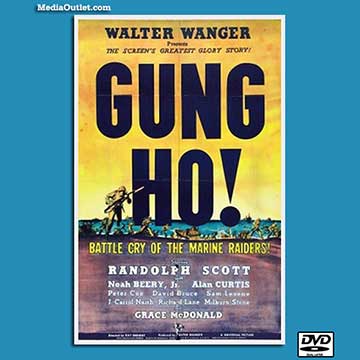
August 17-18, 1942: World War II: The
Pacific War (The Asia-Pacific War, The Pacific Theater Of World
War II): The Pacific Ocean Theater Of World War II: The Gilbert
and Marshall Islands Campaign: The Raid On Makin Island: -- U.S.
Marines raid the Japanese-held Pacific island of Makin (now known
as Butaritari) of the Gilbert Islands in the Pacific Ocean. The
aim was to destroy Imperial Japanese installations, take
prisoners, gain intelligence on the Gilbert Islands area, and
divert Japanese attention and reinforcements from the August 7-9,
1932 Allied landings on the Solomon Islands of Guadalcanal and
Tulagi. The 1943 Hollywood film "Gung Ho" starring
Randolph Scott, Alan Curtis, Noah Beery Jr. And Robert Mitchum is
based on this event. The raid was among the first American
offensive ground combat operations of World War II. The force was
drawn from "Carlson's Raiders", the U.S. Marines 2nd
Raider Battalion, and comprised a small battalion command group
and two of the battalion's six rifle companies. Because of space
limitations aboard ship, each company embarked without one of its
rifle sections. Battalion headquarters, A Company and 18 men from
B Company, totaling 121 troops, were embarked aboard the submarine
Argonaut and the remainder of B Company, totaling 90 men, aboard
Nautilus. The raiding force was designated Task Group 7.15 (TG
7.15). The Imperial Japanese Navy created the Makin Atoll Garrison
in 1942. It was part of the Marshall Islands Garrison, and
officially titled the 62nd Garrison Force. At the time of the
Makin Raid the total force opposing the American landing consisted
of 71 armed personnel of the Japanese seaplane base led by Warrant
Officer (Heisouchou) Kyuzaburo Kanemitsu of the Special Naval
Landing Force equipped with light weapons. In addition there were
also four members of the seaplane tender base and three members of
a meteorological unit. Two civilian personnel were attached to the
Japanese forces as interpreters and civilian administrators. On
Sale Until Midnight Tonight PT!
https://store.earthstation1.com/gung-ho-dvd-1943-randolph-scott-robert-mit1943.html
Today's
EarthStation1.com 15% (Or More!) Off Commemorative Memorial Title:
The OSS In WWII Frank Race & Cloak And Dagger Radio MP3, CD,
USB Drive
Today, August 17, 2026
August 17, 1945: China: The History Of
China: The Century Of Humiliation (The Hundred Years Of National
Humiliation) (1838-1945): The Sino-Japanese Wars: The Second
Sino-Japanese War (The War Of Resistance Against Japanese
Aggression): The Aftermath Of World War II: The Liberation Of
Weihsien Prison Camp: -- The OSS liberates the Weihsien Prison
Camp from the Japanese when four engine tansporrt aircraft flies
over the Japanese prison camp for civilians at Weihsien in North
China, circles it twice, then airdrops an OSS team of parachute
troops within two hundred yards of the perimeter of the camp. They
took over the camp when the Japanese troops, under orders from the
Emperor not to intefere with operations by the victorious Allies,
offered no resistance. Within days, squadrons of giant B-29s were
dropping great loads of food, medicine, and clothing into and
around the camp. Desmond Power, a third-generation Black British
subject and jazz musician born in Tientsin (now Tianjin), China in
1923, was among those civilians incarcerated along with 1,500
other foreign nationals in 1943 during World War II. On Sale Until
Midnight Tonight PT!
https://store.earthstation1.com/frank-race-and-cloak-and-dagger-mp3-cd-2-radio-seri32.html
Today's
EarthStation1.com 15% (Or More!) Off Commemorative Memorial Title:
Korea: The Unknown War TV Korean War Series DVD, Download, USB
Drive
Today, August 17, 2026
August 17, 1950: Korea: The History Of
Korea: The Aftermath Of World War II: The Cold War: The Korean
Conflict: The Cold War (1947-1953): The Cold War In Asia: The
Korean War: The Battle Of The Pusan Perimeter (Korean: Busan
Gyodubo Jeontu) (The Battle Of The Naktong River Defense Line
[Korean: Nagdong-Gang Bang-Eoseon Jeontu]): The Hill 303 Massacre
(Korean: Goji Hagsal Sageon, "The 303 Hill Massacre"):
-- North Korean People's Army (KPA) troops shoot and kill
forty-one US Army prisoners of war on a hill above Waegwan, South
Korea when during one of numerous smaller engagements of the
Battle of Pusan Perimeter. Operating near Taegu during the Battle
Of Taegu, elements of the US 2nd Battalion, 5th Cavalry Regiment,
1st Cavalry Division were surrounded by KPA troops crossing the
Naktong River at Hill 303. Most of the US troops were able to
escape but one platoon of mortar operators misidentified KPA
troops as Republic of Korea Army (ROK) reinforcements and was
captured. KPA troops held the Americans on the hill and initially
tried to move them across the river and out of the battle, but
they were unable to do so because of a heavy counterattack. US
forces eventually broke the KPA advance, routing the force. As the
KPA began to retreat one of their officers ordered the prisoners
to be shot so they would not slow them down. The massacre provoked
a response from both sides in the conflict. US commanders
broadcast radio messages and dropped leaflets demanding the senior
North Korean commanders be held responsible for the atrocity. The
KPA commanders, concerned about the way their soldiers were
treating prisoners of war, laid out stricter guidelines for
handling enemy captives. Memorials were later constructed on Hill
303 by troops at nearby Camp Carroll, to honor the victims of the
massacre. On Sale Until Midnight Tonight PT!
https://store.earthstation1.com/korea-the-unknown-war-dvd-complete-6-part-tv-series-3-dis63.html
Today's
EarthStation1.com 15% (Or More!) Off Commemorative Memorial Title:
Der Ewige Jude The Eternal Jew + Bonus Nuremberg Trials DVD MP4
USB
Today, August 17, 2026
August 17, 1909: #BOTD: Fritz Hippler,
German director, filmmaker and Jew-baiter who ran the film
department in the Propaganda Ministry of Nazi Germany under Joseph
Goebbels, best known as the director of the propaganda film Der
Ewige Jude (The Eternal Jew) (d. May 22, 2002) is #born in Berlin,
Germany where he was brought up as the son of a petty official.
His father died in 1918 in the First World War in France. Hippler
resented the Treaty Of Versailles and its associated regulations,
and rejected the Weimar democracy. In 1925 when he was 17, Hippler
joined the Nazi party NSDAP. In 1927, Hippler became a member of
the NSD StudentBund, the National Socialist German Students'
League. Later he studied law in Heidelberg and Berlin. He was a
member of the Teutonia dueling society in Heidelberg and the
Arminia dueling society in Berlin. In 1932 he became NSDAP
district speaker. In 1933 he was appointed the district and high
school group leader for Berlin-Brandenburg in the National
Socialist German Students' League. Hippler was a supporter of
expressionism. As the leader of the National Socialist German
Students' League of Berlin he organised an exhibition in Humboldt
University of Berlin for expressionist painters, for which he was
vehemently attacked by the Nazi ideologist Alfred Rosenberg. In
1932, Hippler was expelled from the University of Berlin for
participating in violent Nazi rallies. On 19 April 1933, the new
National Socialist Education Minister Bernhard Rust repealed any
disciplinary actions against students associated with the NSDAP,
thus reinstating Hippler. On 22 May 1933, he gave a speech
initiating a march from the student house in the Oranienburger
Strasse to Opera Square with books which were then burned. In June
1933 Hippler participated in a violent rally opposite the stock
exchange, against Alfred Hugenberg then minister of finance and
still Hitler's rival, calling Hitler to disavow him and remove him
from power. Hippler was later involved in a dispute over the
direction of arts policy. He was satisfied with the anti-Jewish
orientation of the arts policy and the consequent banishment of
that art from museums and art dealers who had been created by
people of Jewish faith. However, in July 1933 at a rally of the
National Socialist Student League in the lecture hall of the
Berlin University, he criticised the harsh action of some Nazi
circles against the German modern artists like Emile Nolde and
Barlach, the artists group Die Brucke, which was propagated by
elements of the Nazi leadership as part of efforts against the
Degenerate Art. Hippler earned his PhD in 1934 at the Heidelberg
University with Arnold Bergstraesser and a dissertation titled
"State and Society in the Thinking of John Stuart Mill, Karl
Marx, and Paul de Lagarde. A contribution to the sociological
thinking of the present time". After receiving his doctorate
in 1934, Hippler became a lecturer at the German University of
Policy in Berlin. Starting in 1936 he worked as assistant to Hans
Weidemann working on the production of German newsreels, directed
in the Reich Ministry for Public Enlightenment and Propaganda.
Here he learned the production of documentaries. In January 1939,
he took over Weidemann's position. In 1938, Hippler was appointed
to the rank of SS Hauptsturmfuehrer. According to Veit Harlan,
Hippler loved to wear his SS uniform. In August 1939, Goebbels
promoted Hippler again. appointing the 29-year-old Hippler to head
the film department at the Reich Ministry for Public Enlightenment
and Propaganda RMVP. In October 1942, he was Director in the RMVP.
His task was control, supervision and direction of German
filmmaking. In his ministerial functions, Hippler continued to
produce films. In 1939-40 he was responsible for the propaganda
film "The Campaign In Poland" which ran under the title
of "Baptism Of Fire", and in 1939 "Die Frontschau"
(The Frontshow), a series of shorts shown to soldiers before being
shipped to the Eastern Front. In 1940, he was responsible for the
management and design of the feature-length documentary film "The
Eternal Jew", a film according to Courtade, History of Film
in the Third Reich was "the vilest anti-Semitic Nazi films."
The film historian Frank Noack assessed "The Eternal Jew"
as "probably the most radical inflammatory film of all time".
An article written by Hippler in the magazine "The film"
stated that his film marked Jews as "parasites of national
degeneracy." The film served as a preparation and agreement
of the population in the coming holocaust and was mainly used for
training of police and SS troops. In the same year, Hippler
received from Hitler a secret special endowment of 60,000
Reichsmarks in recognition of his services to the Reich. In 1942,
Hippler published a book about film theory titled Betrachtungen
zum Filmschaffen (i.e., Contemplations on Filmmaking), which
included a preface by Emil Jannings, a German actor popular in
1920s film in Hollywood (and the first Oscar recipient, honored
with the Academy Award for Best Actor in 1929 ceremony, to date,
the only German to have won the Best Actor Oscar). By 1943, he was
promoted to Obersturmbannfuehrer. However, as early as 1939,
Goebbels recorded in his diaries that Hippler was intelligent but
cheeky and totally contradictory. He also stated that Hippler was
immature. Goebbels complained repeatedly about the disorganisation
of the film department. Hippler suffered apparently with alcohol
addiction. Goebbels finally discharged Hippler in June 1943 due to
"mishaps, alcoholism, and family problems", although
Hippler claimed in his diary that he was removed due to his choice
of Erich Kaestner for the screenplay of the film Munchhausen
despite several of Kaestner's books and plays had been banned by
the Nazis in 1933. After his dismissal, Hippler was accused of
falsely denying his partial Jewish descent and demoted from his SS
rank. Hippler was sent to an infantry replacement battalion of the
country, according to Strauss and underwent mountain infantry
training. Then he was again released from active duty and used
until February 1945 as a front cameraman in order to produce
material for newsreels. On 3 May 1945, he flew into Hamburg as a
British prisoner of war. After the end of the Second World War,
Hippler was interned and sentenced to two years in prison. He was
able to stage a comeback after his release. He was interviewed in
the Bill Moyers PBS documentary A Walk Through the 20th Century in
1983. Hippler died at the age of 92 in Berchtesgaden, Bavaria, the
market town where resides Obersalzberg, a mountainside retreat and
the site of Adolf Hitler's former mountain residence, the Berghof.
His burial details are unknown, other than that he was buried in
Germany. He is portrayed by Cary Elwes in the 2001 television
film, Uprising, and by Ralf Bauer in the 2010 film Jew Suss: Rise
and Fall. On Sale Until Midnight Tonight PT!
https://store.earthstation1.com/der-ewige-jude-the-eternal-jew-dvd-nazi-antisemitic-hate-film.html
Today's
EarthStation1.com 15% (Or More!) Off Commemorative Memorial Title:
The Tunnel Under The Wall + Berlin Wall Bonus Titles DVD, MP4, USB
Today, August 17, 2026
August 17, 1962: The Aftermath Of World
War II: The Cold War: The Cold War (1953-1962): The Eastern Bloc
(The Communist Bloc, The Socialist Bloc, The Soviet Bloc): East
Germany (German: Ostdeutschland) (The German Democratic Republic
[GDR] [German: Deutsche Demokratische Republik, DDR]): Berlin: The
History Of Berlin: The Berlin Wall (German: Berliner Mauer):
Deaths At The Berlin Wall: The Death Of Peter Fechter: -- #DOTD:
#RIP: Peter Fechter, German bricklayer who became the
twenty-seventh known person to die at the Berlin Wall (b. January
14, 1944) #dies when he shot and bleeds to death while trying to
cross the new Berlin Wall. Peter Fechter was just 18 years-old
when East German border guards shot and killed him. About a year
after the construction of the Berlin Wall, Fechter and Helmut
Kulbeik attempted to flee from East Germany. The plan was to hide
in a carpenter's workshop near the wall on Zimmerstrasse and,
after observing the border guards from there, to jump out of a
window into the "death-strip" (a strip running between
the main wall and a parallel fence which they had recently started
to construct), run across it, and climb over the two-metre (6.5
ft) wall topped with barbed wire into the Kreuzberg district of
West Berlin near Checkpoint Charlie. Their plan was initially
successful as both Fechter and Kulbeik reached the final wall, but
as they began to climb the East German border guards fired at
them. Although Kulbeik succeeded in crossing over the wall,
Fechter was shot in the pelvis while still climbing, in plain view
of hundreds of witnesses. He fell back into the death-strip on the
East German side, where he remained in view of West German
onlookers, including journalists. Despite his screams, Fechter
received no medical assistance from the East German side, and
could not be tended to by those on the West side. West Berlin
police threw him bandages, which he could not reach, and he bled
to death after approximately one hour. He his buried at th
Auferstehungs-Friedhof in Weissensee, Pankow, Berlin, Germany. As
a result of his death, hundreds in West Berlin formed a
spontaneous demonstration, shouting "Murderers!" at the
border guards. The lack of medical assistance for Peter Fechter
was attributed to mutual fear: Western bystanders were apparently
prevented at gunpoint from assisting him, although according to a
report in Time magazine, a second lieutenant of the US Army on the
scene received specific orders from the US Commandant in West
Berlin to stand firm and do nothing. It also emerged during the
trial that any aid attempt from the West had indeed been made
impossible, but according to a report from forensic pathologist
Otto Prokop, "Fechter had no chance of survival. The shot in
the right hip had caused severe internal injuries." In March
1997, seven years after the reunification of Germany and 35 years
after Fechter's death, two former East German guards, Rolf
Friedrich and Erich Schreiber, faced manslaughter charges for
Fechter's death. Both admitted to the shooting after an intense
investigation. They were both convicted and sentenced to 20 and 21
months' imprisonment on probation. Due to a lack of conclusive
evidence, the court was unable to determine which of three gunmen
(one of whom had already died) had fired the fatal bullet. After
pleading guilty to the crime, during sentencing, both guards
apologized for killing Fechter, saying that if they could take it
back, they would, and that they were honestly remorseful for their
actions. A cross was placed on the western side near the spot
where Fechter was shot and bled to death. At the invitation of
Willy Brandt, the mayor of West Berlin, the Yale Russian Chorus
sang a German translation of Mozart's Ave Verum Corpus near the
site in the week following the shooting. On the first anniversary,
a wreath was placed there by Willy Brandt and US major general
James Polk. The story of Peter Fechter was the headline of
American news magazine Time in August 1962. In this article was
used the noun "Wall of Shame" (Mauer der Schande), and
this became a synonym for the wall. After German Reunification in
1990, the Peter-Fechter-Stelle memorial was constructed on
Zimmerstrasse, at the precise spot where he had died on the
Eastern side, and this has been a focal point for some of the
commemorations regarding the wall. The shooting has also been the
subject of documentaries on German television. Cornelius Ryan
dedicated his book The Last Battle to the memory of Fechter.
Composer Aulis Sallinen wrote an orchestral work Mauermusik to
commemorate Fechter. In 2007, artist Mark Gubb was commissioned by
the Institute of Contemporary Arts to create a performance based
on the death of Peter Fechter. The performance was a one-hour live
piece that was later recorded and screened at the ICA with a
discussion panel at the end consisting of the artist, and actor
Dominik Danielewicz who played the part of Peter Fechter. The 1972
ballad Libre ("Free") - a recording famous in all
Ibero-America - by Spanish singer Nino Bravo, remembers this
event. In 2012 Canadian playwright Jordan Tannahill's play Peter
Fechter: 59 Minutes, a poetic re-imagining of the final hour of
Fechter's life, was produced in Canada and Berlin. Peter Fechter
was born in Berlin, Germany, during the final years of World War
II. Fechter was the third of four children, and raised in the
Weissensee district of Berlin. His father was a mechanical
engineer and his mother was a saleswoman. Fechter finished school
at the age of 14, and graduated as a bricklayer. After World War
II had ended, Weissensee was located in the Soviet occupation zone
of Berlin when the city was divided during the Allied Occupation,
with the Soviet Sector later becoming East Berlin in East Germany.
Fechter's eldest sister had married and now lived in West Berlin,
where she was regularly visited by her parents and siblings. On
August 13, 1961, the East German authorities abruptly closed the
border and began construction of the Berlin Wall, effectively
separating Fechter and his family from his sister in West Berlin.
Fechter's colleague, Helmut Kulbeik, later stated that he and
Fechter had been contemplating defecting to West Berlin for a
while, and that they had also explored the border installations,
but no concrete planning was ever made at the time. Shortly after,
Fechter was denied a legally sanctioned trip to West Germany by
his company, despite receiving good judgement. On Sale Until
Midnight Tonight PT!
https://store.earthstation1.com/the-tunnel-under-the-wall-dvd-1962-berlin-wall-secret-pro1962.html
Today's
EarthStation1.com 15% (Or More!) Off Commemorative Memorial Title:
Spy Machines Of The Cold War: Surveillance & Espionage DVD MP4
USB
Today, August 17, 2026
August 17, 1929: #BOTD: #HBD! Gary
Powers, American pilot whose Central Intelligence Agency (CIA) U-2
spy plane was shot down while flying a reconnaissance mission in
Soviet Union airspace, causing the 1960 U-2 incident (d. August 1,
1977) is #born Francis Gary Powers in Jenkins, Kentucky. On May 1,
1960, a United States U-2 spy plane was shot down by the Soviet
Air Defence Forces while performing photographic aerial
reconnaissance deep into Soviet territory. The single-seat
aircraft, flown by pilot Francis Gary Powers, was hit by an S-75
Dvina (SA-2 Guideline) surface-to-air missile and crashed near
Sverdlovsk (today's Yekaterinburg). Powers parachuted safely and
was captured. Initially, the US authorities acknowledged the
incident as the loss of a civilian weather research aircraft
operated by NASA, but were forced to admit the mission's true
purpose when a few days later the Soviet government produced the
captured pilot and parts of the U-2's surveillance equipment,
including photographs of Soviet military bases taken during the
mission. The incident occurred during the presidency of Dwight D.
Eisenhower and the premiership of Nikita Khrushchev, around two
weeks before the scheduled opening of an east-west summit in
Paris. It caused great embarrassment to the United States and
prompted a marked deterioration in its relations with the Soviet
Union, already strained by the ongoing Cold War. Powers was
convicted of espionage, and on August 19, 1960 sentenced to three
years of imprisonment plus seven years of hard labor but was
released two years later on February 10, 1962 during a prisoner
exchange for Soviet officer Rudolf Abel. Gary Powers died aged 47
in an aircraft crash piloting a helicopter for Los Angeles TV
station KNBC Channel 4 over the San Fernando Valley, killing him
and his cameraman George Spears. They had been recording video
following brush fires in Santa Barbara County in the KNBC
helicopter and were heading back when the crash occurred. His Bell
206 JetRanger helicopter ran out of fuel and crashed at the
Sepulveda Dam recreational area in Encino, California, several
miles short of its intended landing site at Burbank Airport. The
National Transportation Safety Board report attributed the
probable cause of the crash to pilot error. According to Powers'
son, an aviation mechanic had repaired a faulty fuel gauge without
informing Powers, who subsequently misread it. It is surmised
that, at the last moment, he noticed children playing in the area
and directed the helicopter elsewhere to avoid landing on them. He
might have landed safely if not for the last-second deviation,
which compromised his autorotative descent. Powers was survived by
his wife, children (Claudia Dee and Francis Gary Powers Jr.), and
five sisters. He is buried in Arlington National Cemetery as an
Air Force veteran. On Sale Until Midnight Tonight PT!
https://store.earthstation1.com/spy-machines-surveillance-and-intelligence-nova-documentary-dvd.html
Today's
EarthStation1.com 15% (Or More!) Off Commemorative Memorial Title:
The Western Tradition TV Series DVD, MP4 Video Download, USB Drive
Today, August 17, 2026
August 17, 1585: The European Wars Of
Religion: The Eighty Years' War (The Dutch Revolt): The Siege Of
Antwerp (The Fall Of Antwerp [Dutch: Val Van Antwerpen]): -- After
a siege lasting over a year beginning in July 1584, Antwerp is
captured by Spanish forces under Alexander Farnese, Duke of Parma.
Antwerp was the focal point of the Protestant-dominated Dutch
Revolt, but despite this, it was forced to surrender to the
Spanish forces. Under the terms agreed, all Protestants were given
four years to settle their affairs and leave the city. As a
result, over half of the 100,000 inhabitants fled to the northern
provinces, especially to Amsterdam, which became the capital of
the Dutch Republic. In the years that followed, the Spanish
conquest of Antwerp proved to be a centuries-long Pyrrhic victory;
apart from losing a high proportion of its mercantile population,
Antwerp's trade suffered for two centuries as Dutch forts
blockaded the River Scheldt up to 1795. The Eighty Years' War,
also known as the Dutch War Of Independence and The Dutch Revolt
(Dutch: Nederlandse Opstand) (1566/1568-1648) was an armed
conflict in the Habsburg Netherlands between disparate groups of
rebels in the Seventeen Provinces, the Imperial states of the
Habsburg Netherlands, against the political and religious hegemony
of Philip II Of Spain, the sovereign of the Habsburg Netherlands.
The causes of the war included the Reformation, centralisation,
taxation, and the rights and privileges of the nobility and
cities. After the initial stages, Philip II Of Spain, the
sovereign of the Netherlands, deployed his armies and regained
control over most of the rebel-held territories. However,
widespread mutinies in the Spanish army caused a general uprising.
Under the leadership of the exiled William the Silent, the
Catholic and Protestant-dominated provinces sought to establish
religious peace while jointly opposing the king's regime with the
Pacification of Ghent, but the general rebellion failed to sustain
itself. Despite Governor of Spanish Netherlands and General for
Spain, the Duke of Parma's steady military and diplomatic
successes, the Union of Utrecht continued their resistance,
proclaiming their independence through the 1581 Act of Abjuration,
and establishing the Protestant-dominated Dutch Republic in 1588.
In the Ten Years thereafter, the Republic (whose heartland was no
longer threatened) made conquests in the north and east and
received diplomatic recognition from France and England in 1596.
The Dutch colonial empire emerged, which began with Dutch attacks
on Portugal's overseas territories. Facing a stalemate, the two
sides agreed to a Twelve Years' Truce in 1609; when it expired in
1621, fighting resumed as part of the broader Thirty Years' War.
An end was reached in 1648 with the Peace of Munster (a treaty
part of the Peace of Westphalia), when Spain retained Southern
Netherlands (which became modern Belgium) and recognised the Dutch
Republic as an independent country. The European Wars Of Religion
were a series of wars waged in Europe during the 16th, 17th and
early 18th centuries. Fought after the Protestant Reformation
began in 1517, the wars disrupted the religious and political
order in the Catholic countries of Europe, or Christendom. Other
motives during the wars involved revolt, territorial ambitions and
great power conflicts. By the end of the Thirty Years' War
(1618-1648), Catholic France had allied with the Protestant forces
against the Catholic Habsburg monarchy. The wars were largely
ended by the Peace of Westphalia (1648), which established a new
political order that is now known as Westphalian sovereignty. The
conflicts began with the minor Knights' Revolt (1522), followed by
the larger German Peasants' War (1524-1525) in the Holy Roman
Empire. Warfare intensified after the Catholic Church began the
Counter-Reformation against the growth of Protestantism in 1545.
The conflicts culminated in the Thirty Years' War, which
devastated Germany and killed one third of its population, a
mortality rate twice that of World War I. The Peace of Westphalia
broadly resolved the conflicts by recognising three separate
Christian traditions in the Holy Roman Empire: Roman Catholicism,
Lutheranism, and Calvinism. Smaller religious wars continued to be
waged in Western Europe until the 1710s, including the Wars of the
Three Kingdoms (1639-1651) in the British Isles, the
Savoyard-Waldensian wars (1655-1690), and the Toggenburg War
(1712) in the Western Alps. On Sale Until Midnight Tonight PT!
https://store.earthstation1.com/the-western-tradition-dvd-set-all-52-shows-13-d5213.html
Today's
EarthStation1.com 15% (Or More!) Off Commemorative Memorial Title:
The Beginning or the End (1947) Manhattan Project DVD, Download,
USB
Today, August 17, 2026
August 17, 1896: #BOTD: #HBD! Leslie
Groves, American Lieutenant General, United States Army Corps of
Engineers officer who oversaw the construction of the Pentagon and
directed the Manhattan Project, a top secret research project that
developed the atomic bomb during World War II (d. July 13, 1970)
is #born Leslie Richard Groves Jr. in Albany, New York, the son of
a U.S. Army chaplain and pastor and his wife Gwen (nee Griffith)
Groves, and lived at various Army posts during his childhood. In
1918, he graduated fourth in his class at the U.S. Military
Academy at West Point and was commissioned into the U.S. Army
Corps of Engineers. In 1929, he went to Nicaragua as part of an
expedition to conduct a survey for the Inter-Oceanic Nicaragua
Canal. Following the 1931 earthquake, Groves took over Managua's
water supply system, for which he was awarded the Nicaraguan
Presidential Medal of Merit. He attended the Command and General
Staff School at Fort Leavenworth, Kansas, in 1935 and 1936; and
the Army War College in 1938 and 1939, after which he was posted
to the War Department General Staff. Groves developed "a
reputation as a doer, a driver, and a stickler for duty" and
in 1940 he became special assistant for construction to the
Quartermaster General, tasked with inspecting construction sites
and checking on their progress. In August 1941, he was appointed
to create the gigantic office complex for the War Department's
40,000 staff that would ultimately become the Pentagon. In
September 1942, Groves took charge of the Manhattan Project. He
was involved in most aspects of the atomic bomb's development: he
participated in the selection of sites for research and production
at Oak Ridge, Tennessee; Los Alamos, New Mexico; and Hanford,
Washington. He directed the enormous construction effort, made
critical decisions on the various methods of isotope separation,
acquired raw materials, directed the collection of military
intelligence on the German nuclear energy project and helped
select the cities in Japan that were chosen as targets. Groves
wrapped the Manhattan Project in security but failed to prevent
the Soviet Union from conducting a successful espionage program
that stole some of its most important secrets. After the war,
Groves remained in charge of the Manhattan Project until
responsibility for nuclear weapons production was handed over to
the United States Atomic Energy Commission in 1947. He then headed
the Armed Forces Special Weapons Project, which had been created
to control the military aspects of nuclear weapons. He was given a
dressing down by the Army Chief Of Staff, General of the Army
Dwight D. Eisenhower, when they met on 30 January 1948 to evaluate
Groves' performance. Eisenhower recounted a long list of
complaints about Groves pertaining to his rudeness, arrogance,
insensitivity, contempt for the rules and maneuvering for
promotion out of turn. Eisenhower made it clear that Groves would
never become Chief of Engineers. Groves realized that in the
rapidly shrinking postwar military he would not be given any
assignment similar in importance to the one he had held in the
Manhattan Project, as such posts would go to combat commanders
returning from overseas, so three days after his meeting with
Eisenhower, Groves announced his intention to leave the Army. He
was promoted to lieutenant general on 24 January 1948, just before
his retirement on 29 February 1948 in recognition of his
leadership of the Manhattan Project. By special Act of Congress
his date of rank was backdated to 16 July 1945, the date of the
Trinity nuclear test. He went on to become a vice-president at
Sperry Rand in 1948, and retired at age 65 in 1961. Groves
suffered a heart attack caused by chronic calcification of the
aortic valve on 13 July 1970. He was rushed to Walter Reed Army
Medical Center in Washington, where he died at age 73 that night.
A funeral service was held in the chapel at Fort Myer, Virginia,
after which Groves was interred in Arlington National Cemetery
next to his brother Allen, who had died of pneumonia in 1916. On
Sale Until Midnight Tonight PT!
https://store.earthstation1.com/the-beginning-or-the-end-dvd-1947-atomic-bomb-manhattan-pro1947.html
Today's
EarthStation1.com 15% (Or More!) Off Commemorative Memorial Title:
Hess: An Edge Of Conspiracy: A Tale Of Two Murders? MP4 Download
DVD
Today, August 17, 2026
August 17, 1987: #DOTD: Rudolf Hess,
prominent Egyptian-German politician in Nazi Germany (b. April 26,
1894) #dies at the age of 93 in a summer house that had been set
up in the prison garden as a reading room; he had hanged himself
using an extension cord strung over a window latch. A short note
to his family was found in his pocket, thanking them for all that
they had done. The Four Powers released a statement on September
17 ruling the death a suicide. He was initially buried at a secret
location to avoid media attention or demonstrations by Nazi
sympathisers, but his body was re-interred in a family plot at
Wunsiedel on March 17, 1988. He was the last of the major
Nuremberg war criminals to die. Rudolf Walter Richard Hess was
born in Alexandria, Egypt. He was appointed Deputy Fuehrer to
Adolf Hitler in 1933, and was a member of Hitler's inner circle.
He served in this position until 1941, when he flew solo to
Scotland in an attempt to negotiate peace with the United Kingdom
during World War II. He was taken prisoner and eventually was
convicted of crimes against peace, serving a life sentence until
his suicide. Hess enlisted as an infantryman at the outbreak of
World War I. He was wounded several times over the course of the
war and was awarded the Iron Cross, 2nd class, in 1915. Shortly
before the war ended, Hess enrolled to train as an aviator, but he
saw no action in this role. He left the armed forces in December
1918 with the rank of Leutnant der Reserve. In 1919, Hess enrolled
in the University of Munich, where he studied geopolitics under
Karl Haushofer, a proponent of the concept of Lebensraum ("living
space"), which later became one of the pillars of Nazi Party
(NSDAP) ideology. Hess joined the NSDAP on 1 July 1920, and was at
Hitler's side on 8 November 1923 for the Beer Hall Putsch, a
failed Nazi attempt to seize control of the government of Bavaria.
Whilst serving time in jail for this attempted coup, Hess helped
Hitler write his book, Mein Kampf, which became a foundation of
the political platform of the NSDAP. After the Nazi seizure of
power in 1933, Hess was appointed Deputy Fuhrer of the NSDAP and
received a post in Hitler's cabinet. He was the third most
powerful man in Germany, behind only Hitler and Hermann Goering.
In addition to appearing on Hitler's behalf at speaking
engagements and rallies, Hess signed into law much of the
legislation, including the Nuremberg Laws of 1935, which stripped
the Jews of Germany of their rights in the lead-up to the
Holocaust. Hess continued to be interested in aviation, learning
to fly the more advanced aircraft that were coming into
development at the start of World War II. On 10 May 1941 he
undertook a solo flight to Scotland, where he hoped to arrange
peace talks with the Duke of Hamilton, whom he believed to be
prominent in opposition to the British government. Hess was
immediately arrested on his arrival and was held in British
custody until the end of the war, when he was returned to Germany
to stand trial in the Nuremberg Trials of major war criminals in
1946. During much of the trial, he claimed to be suffering from
amnesia, but later admitted this was a ruse. Hess was convicted of
crimes against peace and conspiracy with other German leaders to
commit crimes and was transferred to Spandau Prison in 1947, where
he served a life sentence. Repeated attempts by family members and
prominent politicians to win him early release were blocked by the
Soviet Union. On Sale Until Midnight Tonight PT!
https://store.earthstation1.com/hess-an-edge-of-conspiracy-a-tale-of-two-murders-mp4-download-dvd.html
Today's
EarthStation1.com 15% (Or More!) Off Commemorative Memorial Title:
Surviving Waco: The Survivors Of The Waco Siege MP4 Video Download
DVD
Today, August 17, 2026
August 17, 1959: #BOTD: David Koresh,
American religious cult leader who played a central role in the
Waco Siege Of 1993 (d. April 19, 1993) is #born Vernon Wayne
Howell in Houston, Texas, to a 14-year-old single mother, Bonnie
Sue Clark and father Bobby Wayne Howell. As the head of the Branch
Davidians, a religious sect and offshoot of the Davidian
Seventh-day Adventists, Koresh claimed to be its final prophet.
His apocalyptic Biblical teachings, including interpretations of
the Book of Revelation and the Seven Seals, attracted various
followers. Coming from a dysfunctional background, Koresh was a
member and later a leader of the Branch Davidians, a movement
originally led by Benjamin Roden, based at the Mount Carmel Center
outside Waco, Texas. Here, Koresh competed for dominance with
another leader, Benjamin Roden's son George, until Koresh and his
followers took over Mount Carmel in 1987. In the early 1990s, he
became subject to allegations about polygamy and child sexual
abuse by former Branch Davidian associates, although investigation
by authorities found no conclusive evidence. Further allegations
related to the Branch Davidians' stockpiling of weapons led the
Bureau of Alcohol, Tobacco, and Firearms (ATF) and later the FBI
to launch a raid on the group's Mount Carmel compound in February
1993. During the 51-day siege and violence that ensued, Koresh was
wounded by ATF forces and later died of a gunshot in unclear
circumstances as the compound was destroyed in a fire. He is
buried at Tyler Memorial Park And Cemetery, Tyler, Texas. On Sale
Until Midnight Tonight PT!
https://store.earthstation1.com/surviving-waco-the-survivors-of-the-waco-siege-mp4-video-download-dvd.html
Today's
EarthStation1.com 15% (Or More!) Off Commemorative Memorial Title:
The 1989 Tiananmen Square Protests DVD, MP4 Download, USB Flash
Drive
Today, August 17, 2026
August 17, 1926: #BOTD: #HBD! Jiang
Zemin, Chinese engineer and politician, former General Secretary
of the Communist Party of China from 1989 to 2002, 5th President
of China from 1993 to 2003 (d. November 30, 2022) is #born Zemin
Jiang in Yangzhou, Jiangsu, Kiangtu County, Kiangsu, Republic Of
China. Jiang has been described as the "core of the third
generation" of Communist Party leaders since 1989. Jiang came
to power unexpectedly as a compromise candidate following the
Tiananmen Square protests of 1989, when he replaced Zhao Ziyang as
General Secretary after Zhao was ousted for his support for the
student movement. With the waning influence of Eight Elders due to
old age and with the death of Deng Xiaoping in 1997, Jiang
consolidated his hold on power and became the "paramount
leader" of the party and the country in the 1990s. Urged by
Deng's Southern Tour in 1992 to accelerate "opening up and
reform", Jiang officially introduced the term "socialist
market economy" in his speech during the 14th National
Congress of the Communist Party of China held later that year,
ending a period of ideological uncertainty and economic stagnation
following 1989. Under Jiang's leadership, China experienced
substantial economic growth with the continuation of reforms, saw
the peaceful return of Hong Kong from the United Kingdom in 1997
and Macau from Portugal in 1999 and improved its relations with
the outside world while the Communist Party maintained its tight
control over the government. His contributions to party doctrine,
known as the "Three Represents," were written into the
party's constitution in 2002. Jiang vacated the post of party
General Secretary and Politburo Standing Committee in 2002, but
did not relinquish all of his leadership titles until 2005, and
continued to influence affairs until much later. Jiang is the
longest-living paramount leader in the history of the PRC,
surpassing Deng Xiaoping on February 14, 2019. Jiang Zemin died in
Shanghai, China at 12:13 pm from leukemia and multiple organ
failures, according to the Chinese state media Xinhua News Agency.
On the day of Jiang's death, the government released a notice that
the national flags would be flown half-staff in key locations of
Beijing and diplomatic missions abroad. Due to the ceaseless
boorish behavior of cultural revolution-raised Xi Jinping,
foreigners were not invited to attend official mourning
activities. His remains were cremated, and his ashes were
scattered into the mouth of Yangtze River. On Sale Until Midnight
Tonight PT!
https://store.earthstation1.com/the-1989-tiananmen-square-protests-dvd-mp4-usb-19894.html
Today's
EarthStation1.com 15% (Or More!) Off Commemorative Memorial Title:
DJ Madness! 1950s-60s-70s Radio Shows DVD, MP3 Download, USB Drive
Today, August 17, 2026
August 17, 1933: #BOTD: #HBD! Mark
Dinning, American pop singer, best known for the 1960 No. 1 single
"Teen Angel", brother of "The Dinning Sisters"
Virginia and Lucille Dinning, uncle of Dean Dinning, bass
guitarist for alternative rock band Toad the Wet Sprocket (d.
March 22, 1986) is #born Max Edward Dinning in Manchester,
Oklahoma. He followed his sisters and pursued a career in country
music and, in 1957, record producer Wesley Rose signed him to a
recording contract as Mark Dinning. His recording efforts met with
limited success until 1959, when "Teen Angel" became a
hit. The lyrics, which told of the death of a teenage girl, were
deemed by British radio stations to be too morbid to be aired, but
it reached number 37 on the UK Singles Chart. In the U.S., it
reached number one on the Billboard charts in early February 1960.
It sold over one million copies and was awarded a gold disc. He
also was the original artist to record "What Will My Mary
Say", a song later popularized by Johnny Mathis in 1963.
Dinning had an alcohol addiction, which restricted his
performances, and caused promoters to stop booking him as he faded
from public view. Although Dinning never duplicated the success of
"Teen Angel", he had three minor hit records in the
ensuing years. Dinning continued performing until his death from a
heart attack in Jefferson City, Missouri, at the age of 52. He is
buried at Dry Fork Cemetery in New Bloomfiled, Missouri. On Sale
Until Midnight Tonight PT!
https://store.earthstation1.com/dj-radio-airchecks-mp3-dvd-1950s60s70s-dis319506070.html
Today's
EarthStation1.com 15% (Or More!) Off Commemorative Memorial Title:
Complete TV Music & Dance MegaSet DVDs, Downloads, USB Flash
Drives
Today, August 17, 2026
August 17, 1946: #BOTD: #HBD! Drake
Levin, American musician best known as the guitarist for the
pop-rock band Paul Revere & The Raiders (d. July 4, 2009) is
#born Drake Maxwell Levin in Chicago into a Jewish family that
shortened its name from Levinshefski a few years before his birth.
Levin joined Paul Revere & the Raiders when he was 16 years
old, which earned him the nickname "The Kid" from Paul
Revere. His addition helped establish Paul Revere and the Raiders
as a premier showband in the Northwest United States. Levin's
performances included synchronized dance steps, playing on his
knees, standing on his amplifier and playing his guitar behind his
head. After a performance at Seattle's Spanish Castle Ballroom, a
young man who had watched from the front of the stage all evening
approached Drake. He said that Drake's playing had inspired him
and said he was a really good showman. As Drake thanked him and
they shook hands, Drake asked the young man his name and he
replied, "Jimi Hendrix." The Raiders became a national
teen sensation from their daily television exposure on the ABC
television show Where The Action Is. It was during that time that
Levin and the Raiders produced many hit records. Levin's
blues-based guitar style helped drive the band's raw, edgy sound.
Levin's synchronized dance steps and stage antics with fellow
Raider bassist Phil "Fang" Volk earned the pair the
nickname "The Twins". In 1966, Levin left the performing
version of the band to fulfill his military service obligation by
joining the National Guard. This enabled him to continue recording
in the studio with the group during his time off. Levin's guitar
work and background vocals can be heard on Raiders albums through
The Spirit of '67, although his name and photo do not appear on
the album cover with the band. Jim "Harpo" Valley had
stepped into Levin's place on the Raiders' television and concert
performances, thus Valley's photo appears with the band on that
particular album. When Volk became ill and could not tour, Levin
stepped in to cover for his friend on a few dates, filling in for
Volk on bass. When Levin's performing replacement, Valley, decided
to leave the band after a little over a year with the group, Levin
again rejoined the Raiders to help them finish their spring 1967
tour. Levin was to perform with the Raiders on the Ed Sullivan
Show on April 30, 1967, but band leader Paul Revere was upset at
the pending departure of Volk and drummer Mike "Smitty"
Smith and believed Levin to be partially responsible. Unknown to
the group, Revere had hired a replacement guitarist, Freddy
Weller, to perform with the group on the Sullivan show, leaving
Levin to watch the Raiders' only Ed Sullivan Show performance as a
spectator. Volk and Smith left the band after the Sullivan
performance and Levin re-teamed with them in Brotherhood. The band
was signed to RCA, but were hindered by the members' lingering
contractual obligations to Columbia Records from their Raiders
work. The power trio released three albums, two under the
Brotherhood name in 1968 and 1969 and a third album in 1969 called
Joyride under the name Friendsound. Joyride was an experimental
album that was included on the 1979 Nurse with Wound list. Levin
owned and played a triple-pickup Epiphone Crestwood Custom Deluxe
in his early Raiders days, including the pilot episode of Where
The Action Is. A few TV performances appearances of the band
showed Drake playing a Mosrite six- and 12-string doubleneck that
was offered to him from Mosrite, but he found it too heavy to play
comfortably. He was also seen televised with a Vox Phantom VI,
because of the band's Vox endorsement deal. However, he did not
use them live or even in the studio as he thought they were poorly
made instruments. Drake did use bandmate Phil Volk's 1960 Fender
Stratocaster in the studio. In his later years, Levin played a
reissue 62 Fender Stratocaster and a Fender Telecaster. However,
he is most widely associated with his cherry red 1963 Epiphone
Sheraton, with which he recorded his double-tracked guitar solo on
"Just Like Me." After his death, it was purchased by the
Musicians Hall of Fame in Nashville, TN in early 2010, but it was
severely damaged just a couple of months later in the May 2010
Nashville flood. Levin subsequently performed with artists such as
Ananda Shankar, Emitt Rhodes, and Lee Michaels (on the album
Barrel). He also participated in reunions of various ex-members of
the Raiders, and worked with his friend Phil Volk on several
occasions. Drake Levin died aged 62 of cancer at his home in San
Francisco, California with his wife Sandra at his side. His
remains were cremated, and the ashes given to his widow. On Sale
Until Midnight Tonight PT!
https://store.earthstation1.com/14-disc-classic-tv-music-amp-dance-shows-discount-dvd-megas14.html
Today's
EarthStation1.com 15% (Or More!) Off Commemorative Memorial Title:
Clive James' Fame In The 20th Century TV Series DVD Set MP4 USB
Drive
Today, August 17, 2026
August 17, 1943: #BOTD: #HBD! Robert De
Niro, American actor, entrepreneur, director, and producer, is
#born Robert Anthony De Niro Jr. in the Manhattan borough of New
York City, the only child of painters Virginia Admiral and Robert
De Niro Sr. His father was of Irish and Italian descent, while his
mother had Dutch, English, French, and German ancestry. His
parents, who had met at the painting classes of Hans Hofmann in
Provincetown, Massachusetts, separated when he was two years old
after his father announced that he was gay. He was raised by his
mother in the Greenwich Village and Little Italy neighborhoods of
Manhattan. His father lived nearby, and remained close with De
Niro during his childhood. Nicknamed "Bobby Milk"
because of his pale complexion, De Niro befriended many street
kids in Little Italy, much to the disapproval of his father. Some,
however, have remained his lifelong friends. His mother was raised
Presbyterian but became an atheist as an adult, while his father
had been a lapsed Catholic since the age of 12. Against his
parents' wishes, his grandparents had De Niro secretly baptized
into the Catholic Church while he was staying with them during his
parents' divorce. He grew up to be particularly known for his nine
collaborations with filmmaker Martin Scorsese, and is the
recipient of various accolades, including two Academy Awards, a
Golden Globe Award, the Cecil B. DeMille Award, and a Screen
Actors Guild Life Achievement Award. In 2009, De Niro received the
Kennedy Center Honor, and received a Presidential Medal Of Freedom
from U.S. President Barack Obama in 2016. De Niro studied acting
at HB Studio, Stella Adler Conservatory, and Lee Strasberg's
Actors Studio. His first major role was in Greetings (1968), and
he gained early recognition with his role as a baseball player in
the sports drama Bang the Drum Slowly (1973). De Niro's first
collaboration with Scorsese was Mean Streets (1973), where he
played small-time NYC crook "Johnny Boy". Stardom
followed with his role as young Vito Corleone in Francis Ford
Coppola's crime epic The Godfather Part II (1974), which won De
Niro the Academy Award for Best Supporting Actor. For his
portrayal of Travis Bickle in Taxi Driver (1976) and a soldier in
the Vietnam War drama The Deer Hunter (1978), he earned two
nominations for the Academy Award for Best Actor. De Niro won the
Academy Award for Best Actor for his portrayal of world
middleweight boxing champion Jake LaMotta in Scorsese's
biographical drama Raging Bull (1980), his first Oscar in this
category. He soon thereafter diversified to other roles, playing a
stand-up comic in The King of Comedy (1982), and gained further
recognition for his performances in Bernardo Bertolucci's epic
1900 (1976), Sergio Leone's crime epic Once Upon a Time in America
(1984), Terry Gilliam's dystopian satire Brazil (1985), the
religious epic The Mission (1986), and the comedy Midnight Run
(1988). De Niro portrayed gangster Jimmy Conway in Goodfellas
(1990), a catatonic patient in the drama Awakenings (1990), and a
criminal in the psychological thriller Cape Fear (1991). All three
films received praise for De Niro's performances. He then starred
in This Boy's Life (1993), and directed his first feature film
with 1993's A Bronx Tale. His other critical successes include the
crime films Heat (1995) and Casino (1995). He is also known for
his comic roles in latter Wag the Dog (1997), Analyze This (1999),
and Meet the Parents (2000). After appearing in several critically
panned and commercially unsuccessful films, he earned an Academy
Award nomination for Best Supporting Actor for his performance in
David O. Russell's 2012 romantic comedy Silver Linings Playbook.
In 2017, De Niro portrayed Bernie Madoff in The Wizard of Lies,
earning a Primetime Emmy Award nomination. He then starred in the
psychological thriller Joker (2019) and Scorsese's crime epic The
Irishman (2019). De Niro and producer Jane Rosenthal founded the
film and television production company TriBeCa Productions in
1989, which has produced several films alongside his own. Also
with Rosenthal, he founded the Tribeca Film Festival in 2002. Six
of De Niro's films have been inducted into the United States
National Film Registry by the Library of Congress as being
"culturally, historically, or aesthetically significant".
On Sale Until Midnight Tonight PT!
https://store.earthstation1.com/clive-james39-fame-in-the-20th-century-tv-series-dvd-set-mp4-usb-39204.html
Today's
EarthStation1.com 15% (Or More!) Off Commemorative Memorial Title:
My Little Chickadee (1940) W.C. Fields And Mae West DVD, Download,
USB
Today, August 17, 2026
August 17, 1893: #BOTD: #HBD! Mae West,
American actress, singer, playwright, screenwriter, comedian, and
sex symbol (d. November 22, 1980) is #born Mary Jane West in
Brooklyn, New York (either Greenpoint or Bushwick) before New York
City was consolidated in 1898. Mae West had an entertainment
career that spanned seven decades. Known for her lighthearted
bawdy double entendres, and breezy sexual independence, West made
a name for herself in vaudeville and on the stage in New York City
before moving to Hollywood to become a comedian, actress, and
writer in the motion picture industry, as well as appearing on
radio and television. For her contributions to American cinema,
the American Film Institute named West 15th among the greatest
female stars of classic American cinema. One of the more
controversial movie stars of her day, West encountered many
problems, especially censorship. She bucked the system, making
comedy out of prudish conventional mores, and the Depression-era
audience admired her for it. When her cinematic career ended, she
wrote books and plays, and continued to perform in Las Vegas, in
the United Kingdom, and on radio and television, and to record
rock and roll albums. Asked about the various efforts to impede
her career, West replied: "I believe in censorship. I made a
fortune out of it." While true, she also suffered greatly
because of it, even going to jail for her right to freedom of
speech. Mae West died at Good Samaritan Hospital in Los Angeles,
California aged aged 87 from the effects of a stroke caused when
she tripped while getting out of bed the prior August. A private
service was held at the church in Forest Lawn, Hollywood Hills, on
November 25, 1980. Bishop Andre Penachio, a friend, officiated at
the entombment in the family mausoleum at Cypress Hills Abbey,
Brooklyn, purchased in 1930 when her mother died. Her father and
brother were also entombed there before her, and her younger
sister, Beverly, was laid to rest in the last of the five crypts
less than 18 months after West's death. On Sale Until Midnight
Tonight PT!
https://store.earthstation1.com/my-little-chicadee-dvd-1940-wc-fields-mae-1940.html
Today's
EarthStation1.com 15% Off Commemorative Memorial Title: The Age Of
The Enlightenment TV College Course DVD, Download, USB
Today, August 17, 2026
August 17, 1786: #DOTD: #RIP: Frederick
The Great, King Frederick II In Prussia from 1740 until 1772, King
Of Prussia from 1772 until his death in 1786, whose most
significant accomplishments during his reign included his military
victories, his reorganization of Prussian armies, his patronage of
the arts and the Enlightenment in Prussia, and his final success
against great odds in the Seven Years' War, author of
Anti-Machiavel, an idealistic rebuttal of Machiavelli (b. January
24, 1712) #dies aged 74 died in an armchair in his study at his
favorite residence, Sanssouci in Potsdam, aged 74. Because he died
childless, Frederick was succeeded by his nephew, Frederick
William II, son of his brother, Augustus William. He left
instructions that he should be buried next to his greyhounds on
the vineyard terrace, on the side of the corps de logis of
Sanssouci. His nephew and successor Frederick William II instead
ordered Frederick's body to be entombed next to his father,
Frederick William I, in the Potsdam Garrison Church. Near the end
of World War II, German dictator Adolf Hitler ordered Frederick's
coffin to be hidden in a salt mine as protection from destruction.
The United States Army relocated the remains to Marburg in 1946;
in 1953, the coffins of Frederick and his father were moved to
Burg Hohenzollern. On the 205th anniversary of his death in 1991,
Frederick's coffin lay in state in the court of honour at
Sanssouci, covered by a Prussian flag and escorted by a Bundeswehr
guard of honour. After nightfall, Frederick's body was finally
laid to rest in the terrace of the vineyard of Sanssouci - in the
still existing crypt he had built there - without pomp, in
accordance with his will. Visitors to his grave often place
potatoes on his gravestone in honour of his role in promoting the
use of the potato in Prussia. Frederick The Great was born
Frederick Hohenzollern in Berlin, Kingdom of Prussia. Frederick
was the last titled King in Prussia and declared himself King of
Prussia after achieving full sovereignty for all historical
Prussian lands, and had the longest reign of any Hohenzollern
king. Prussia had greatly increased its territories and became a
leading military power in Europe under his rule. He became known
as Frederick The Great (Friedrich der Grosse) and was
affectionately nicknamed Der Alte Fritz ("Old Fritz") by
the Prussian and later by all German people. In his youth,
Frederick was more interested in music and philosophy than the art
of war. Nonetheless, upon ascending to the Prussian throne, he
attacked Austria and claimed Silesia during the Silesian Wars,
winning military acclaim for himself and Prussia. Toward the end
of his reign, Frederick physically connected most of his realm by
acquiring Polish territories in the First Partition of Poland. He
was an influential military theorist whose analysis emerged from
his extensive personal battlefield experience and covered issues
of strategy, tactics, mobility and logistics. Considering himself
"the first servant of the state," Frederick was a
proponent of enlightened absolutism. He modernized the Prussian
bureaucracy and civil service and pursued religious policies
throughout his realm that ranged from tolerance to segregation. He
reformed the judicial system and made it possible for men not of
noble stock to become judges and senior bureaucrats. Frederick
also encouraged immigrants of various nationalities and faiths to
come to Prussia. Some critics, however, point out his oppressive
measures against conquered Polish subjects during the First
Partition. Frederick supported arts and philosophers he favored,
as well as allowing complete freedom of the press and literature.
Frederick was primarily homosexual, and his sexual orientation was
central to his life. Though he had an arranged marriage, Frederick
produced no children and was succeeded by his nephew. His favoured
courtiers were exclusively male, and his art collection celebrated
homoeroticism. Persistent rumours connecting the king with
homosexual activity circulated around Europe during his lifetime,
but there is less surviving definitive evidence of any sexual
relationships of his, homosexual or otherwise. However, in July
1750, the Prussian king unmistakably wrote to his gay secretary
and reader, Claude Etienne Darget: "Mes hemorroides salient
affectueusement votre v[[[" ("My hemorrhoids
affectionately greet your cock"), indicating that he was an
active homosexual who practiced passive anal intercourse with men.
At an advanced age, the king advised a nephew in a letter against
passive anal intercourse, which from his own experience was "not
very pleasant". His homosexuality is further made clear from
statements by his famous contemporaries, Voltaire and Giacomo
Casanova, who personally knew him and his sexual preferences.
Significantly, Voltaire nicknamed Frederick "Luc"; which
when read backwards spells "cul", the vulgar French term
for "anus" or "butt". Nearly all 19th-century
German historians made Frederick into a romantic model of a
glorified warrior, praising his leadership, administrative
efficiency, devotion to duty and success in building up Prussia to
a great power in Europe. Historian Leopold von Ranke was
unstinting in his praise of Frederick's "Heroic life,
inspired by great ideas, filled with feats of arms ...
immortalized by the raising of the Prussian state to the rank of a
power." Johann Gustav Droysen was even more extolling.
Frederick remained an admired historical figure through the German
Empire's defeat in the First World War, and the Nazis glorified
him as a great German leader pre-figuring Hitler, but his
reputation in both East and West Germany became far less favorable
after the fall of the Nazi regime, largely due to his status as a
favorite icon of the Nazis. However, by the 21st century, a
re-evaluation of his legacy as a great general and enlightened
monarch returned opinion of him to favour. On Sale @ 15% Off
Discount Till Midnight PT!
https://store.earthstation1.com/the-age-of-enlightenment-5-episodes-tv-college-course-2-dv52.html
Today's
EarthStation1.com #OnThisDay Commemorative Memorial Title: The
Night That Panicked America: War Of The Worlds DVD, Download, USB
Today, August 17, 2026 August 17, 1995: #DOTD: #RIP: Howard E.
Koch, American playwright and screenwriter whose radio work in the
1930s as a writer for the CBS Mercury Theater of the Air included
the Orson Welles radio drama The War Of The Worlds (1938), which
caused nationwide panic among some listeners for its
documentary-like portrayal of an invasion of spaceships from Mars,
screenwriter of the classic World War II drama film Casablanca,
blacklisted by the Hollywood movie studio bosses in the 1950s (b.
December 12, 1901) #dies in Woodstock, northwest of Kingston, New
York, aged 94. He is buried at The Artists Cemetery in Woodstock,
New York, Howard E. Koch was born Howard Everard Koch into a
Jewish family in New York City. He was a graduate of St. Stephen's
College (1922, later renamed Bard College) and Columbia Law School
(1925). While practicing law in Hartsdale, New York, he began to
write plays. Great Scott (1929), Give Us This Day (1933), and In
Time to Come (1941) which were produced by Broadway. Koch began
playwriting in the late 1920s before he started working on radio
scripts. In the 1930s, he worked as a writer for the CBS Mercury
Theater of the Air. The work included the Orson Welles radio drama
The War of the Worlds (1938), which allegedly caused nationwide
panic among some listeners for its documentary-like portrayal of
an invasion of spaceships from Mars. Koch later wrote a play about
the panic, Invasion from Mars, which was later adapted into the
1975 TV movie, The Night That Panicked America, in which actor
Joshua Bryant plays Koch. In the 1940s, Koch began writing for
Hollywood studios. His first accepted works were screenplays for
Michael Curtiz's The Sea Hawk, William Wyler's The Letter. Koch
contributed to the popular film Casablanca with Humphrey Bogart,
which he co-scripted with writers Julius and Philip Epstein in
1942, and for which he received an Academy Award in 1943. He also
wrote Shining Victory (1941) and Letter from an Unknown Woman
(1948), his favorite screenplay. In 1943, at the request of Jack
L. Warner of Warner Bros., Koch wrote the screenplay for Mission
to Moscow (1943). The movie subsequently spawned controversy
because of its positive portrayal of Joseph Stalin and the Soviet
Union. After the war, Koch was dismissed after he was denounced as
a Communist. He was then criticized by the House Un-American
Activities Committee (HUAC) for his outspoken leftist political
views. Koch was blacklisted by Hollywood in 1951. After being
blacklisted, Koch moved with his wife, Anne (an accomplished
writer in her own right) and their family to Europe and eventually
took up residence in the United Kingdom with other blacklisted
writers, where they wrote for five years for film and television
(British television series The Adventures of Robin Hood among
them) under the pseudonyms "Peter Howard" and "Anne
Rodney". In 1956, they returned to the United States and
settled in Woodstock, New York. Koch sought help from high-profile
lawyer Ed Williams in order to clear his name from Hollywood's
blacklist. Koch was promptly removed from the blacklist, and he
resumed his name and continued to write plays and books and
remained actively committed to progressive political and social
justice causes. His last Hollywood screenplay was for The Fox in
1968.
https://store.earthstation1.com/the-night-that-panicked-america-dvd-war-of-the-worlds-broadcast.html
August 17, 1995: #DOTD: #RIP: Howard E.
Koch, American playwright and screenwriter whose radio work in the
1930s as a writer for the CBS Mercury Theater of the Air included
the Orson Welles radio drama The War Of The Worlds (1938), which
caused nationwide panic among some listeners for its
documentary-like portrayal of an invasion of spaceships from Mars,
screenwriter of the classic World War II drama film Casablanca,
blacklisted by the Hollywood movie studio bosses in the 1950s (b.
December 12, 1901) #dies in Woodstock, northwest of Kingston, New
York, aged 94. He is buried at The Artists Cemetery in Woodstock,
New York, Howard E. Koch was born Howard Everard Koch into a
Jewish family in New York City. He was a graduate of St. Stephen's
College (1922, later renamed Bard College) and Columbia Law School
(1925). While practicing law in Hartsdale, New York, he began to
write plays. Great Scott (1929), Give Us This Day (1933), and In
Time to Come (1941) which were produced by Broadway. Koch began
playwriting in the late 1920s before he started working on radio
scripts. In the 1930s, he worked as a writer for the CBS Mercury
Theater of the Air. The work included the Orson Welles radio drama
The War of the Worlds (1938), which allegedly caused nationwide
panic among some listeners for its documentary-like portrayal of
an invasion of spaceships from Mars. Koch later wrote a play about
the panic, Invasion from Mars, which was later adapted into the
1975 TV movie, The Night That Panicked America, in which actor
Joshua Bryant plays Koch. In the 1940s, Koch began writing for
Hollywood studios. His first accepted works were screenplays for
Michael Curtiz's The Sea Hawk, William Wyler's The Letter. Koch
contributed to the popular film Casablanca with Humphrey Bogart,
which he co-scripted with writers Julius and Philip Epstein in
1942, and for which he received an Academy Award in 1943. He also
wrote Shining Victory (1941) and Letter from an Unknown Woman
(1948), his favorite screenplay. In 1943, at the request of Jack
L. Warner of Warner Bros., Koch wrote the screenplay for Mission
to Moscow (1943). The movie subsequently spawned controversy
because of its positive portrayal of Joseph Stalin and the Soviet
Union. After the war, Koch was dismissed after he was denounced as
a Communist. He was then criticized by the House Un-American
Activities Committee (HUAC) for his outspoken leftist political
views. Koch was blacklisted by Hollywood in 1951. After being
blacklisted, Koch moved with his wife, Anne (an accomplished
writer in her own right) and their family to Europe and eventually
took up residence in the United Kingdom with other blacklisted
writers, where they wrote for five years for film and television
(British television series The Adventures of Robin Hood among
them) under the pseudonyms "Peter Howard" and "Anne
Rodney". In 1956, they returned to the United States and
settled in Woodstock, New York. Koch sought help from high-profile
lawyer Ed Williams in order to clear his name from Hollywood's
blacklist. Koch was promptly removed from the blacklist, and he
resumed his name and continued to write plays and books and
remained actively committed to progressive political and social
justice causes. His last Hollywood screenplay was for The Fox in
1968.
https://store.earthstation1.com/the-night-that-panicked-america-dvd-war-of-the-worlds-broadcast.html
Today's
EarthStation1.com #OnThisDay Commemorative Memorial Title: The Old
Time Radio Comedy MegaSet MP3 Collection DVD, Download, USB
Today, August 17, 2026August 17, 1963: #DOTD: #RIP: Ed Gardner,
American comic actor, writer and director, best remembered as the
creator and star of the radio's popular Duffy's Tavern comedy
series (b. June 29, 1901) #dies at age 62 of a liver ailment at
Good Samaritan Hospital in Los Angeles. He was interred in The
Chapel Of The Pines at Hollywood Forever Cemetery, Hollywood. Ed
Gardner was born Edward Poggenberg in Astoria, New York. His
character "Archie" on Duffy's Tavern was the inspiration
for the character Archie Bunker on All In The Family and Archie
Bunker's Place, and both characters constantly communicated with
malaprops (i.e. "Leave us not jump to seclusion") and
mixed metaphors, and both characters managed a tavern, with both
using the phrase "Archie the manager speaking' when answering
the telephone at their Taverns. Duffy's Tavern was an American
radio situation comedy that ran for a decade on several networks
(CBS, 1941-42; NBC-Blue Network, 1942-44; and NBC, 1944-51),
concluding with the December 28, 1951, broadcast. The program
often featured celebrity guest stars but always hooked them around
the misadventures of Archie. Archie was prone to involvement in
get-rich-quick schemes and romantic missteps. Some of Gardner's
once-famous malaprops as Archie on Duffy's Tavern include: "Opera
is when a guy gets stabbed in the back and instead of bleeding, he
sings"; "Now, don't infirm me that I'm stupid";
"Fate has fickled its finger at me"; "Get me the
lost and foundling division"; and "There's two kinds of
guys go to church - them that doesn't and them that don't."
https://store.earthstation1.com/old-time-radio-comedy-mp3-dvd-megaset-2-dis32.html
Today's
EarthStation1.com #OnThisDay Commemorative Memorial Title: George
Gershwin Remembered DVD, MP4 Video Download, USB Flash Drive
Today, August 17, 2026August 17, 1983: #DOTD: #RIP: Ira
Gershwin, American songwriter and lyricist who collaborated with
his younger brother, composer George Gershwin, to create some of
the most memorable songs of the 20th century (b. 1896) #dies of
heart disease in Beverly Hills, California at the age of 86. He is
interred at Westchester Hills Cemetery, Hastings-on-Hudson, New
York. Ira Gershwin was born Israel Gershowitz in New York
City.With George he wrote more than a dozen Broadway shows,
featuring songs such as "I Got Rhythm", "Embraceable
You", "The Man I Love" and "Someone to Watch
Over Me". He was also responsible, along with DuBose Heyward,
for the libretto to George's opera Porgy and Bess. The success the
Gershwin brothers had with their collaborative works has often
overshadowed the creative role that Ira played. His mastery of
songwriting continued, however, after the early death of George.
He wrote additional hit songs with composers Jerome Kern, Kurt
Weill, Harry Warren and Harold Arlen. His critically acclaimed
1959 book Lyrics on Several Occasions, an amalgam of autobiography
and annotated anthology, is an important source for studying the
art of the lyricist in the golden age of American popular song.
https://store.earthstation1.com/george-gershwin-remembered-dvd-1987-tv-documen1987.html
Today's
EarthStation1.com #OnThisDay Commemorative Memorial Title: TV
Music & Dance Shows #10 Shindig & Shinrock DVD, MP4, USB
Drive
Today, August 17, 2026August 17, 1973: #DOTD: #RIP: Paul
Williams, African American singer and choreographer, one of the
founding members and original lead singer of the Motown group The
Temptations (b. July 2, 1939) #dies of an apparent but suspicious
suicide in Detroit, Michigan, two years after personal problems
and failing health forced Williams to retire, aged 34. Paul
Williams was found dead inside a car parked in an alley having
just left the new house of his then-girlfriend after an argument.
A gun was found near his body. His death was ruled an apparent
suicide. According to fellow Temptations member Otis Williams,
Paul had expressed suicidal thoughts to him and Melvin Franklin
months before his death. Williams's funeral was held on August 24,
with his family and former bandmates in attendance. He was
survived by his wife, Mary Agnes Williams, and five children:
Sarita, Kenneth, Paula, Mary and Paul Jr. Paul Jr later joined a
Temptations splinter group, the Temptations Review featuring
Dennis Edwards. Williams also had three other children, Paul
Williams Lucas, Anthony Johnson, and Derrick Vinyard, with three
girlfriends. Williams is buried at Lincoln Memorial Park Cemetery,
Clinton Township, Macomb County, Michigan in Lot 275, Grave #4,
Section #G. The circumstances surrounding Williams's death caused
the Williams family to suspect that some form of foul play was the
actual cause of Williams's death. According to the coroner,
Williams had used his right hand to shoot himself on the left side
of his head. In addition, a bottle of alcohol was found near
Williams's left side, as if he had dropped it while being shot.
The gun used in the shooting was found to have fired two shots,
only one of which had killed Williams. Paul Williams was born in
the Ensley neighborhood of Birmingham, Alabama, where he was
raised. Along with David Ruffin, Otis Williams, and fellow
Alabamians Eddie Kendricks and Melvin Franklin, Williams was a
member of The Temptations during the "Classic Five"
period. Paul Williams and his bandmates endured a long series of
failed singles before finally hitting the Billboard Top 20 in 1964
with "The Way You Do the Things You Do". More hits
quickly followed, including "My Girl", "Ain't Too
Proud To Beg" and "(I Know) I'm Losing You".
Although Williams had been the group's original lead singer during
its formative years, by 1965, his role had been eclipsed by David
Ruffin and Eddie Kendricks, who had both sung lead on Temptations
hit singles. As such, Williams was often overlooked for leads,
even on album tracks and B-sides, prompting him to complain "Shit,
I can sing too!" In response, he was given lead vocals on the
song, "Don't Look Back" (1965). Williams sang lead on
several of the group's songs, and served as the main lead singer
during the group's early years. His early leads include, "Your
Wonderful Love" (1961), "Slow Down Heart" (1962),
"I Want a Love I Can See" (1963), and "Oh, Mother
of Mine" (1961) (the group's first single) and "Farewell
My Love" (1963) both shared with Eddie Kendricks. Considered
the Temptations' best dancer, Williams served as the group's
original choreographer, devising routines for his group and the
Supremes (most notably their trademark "Stop! In the Name of
Love" routine), before Cholly Atkins took over that role for
all of Motown's acts. Williams' later leads on Temptations songs
include, "Just Another Lonely Night" (1965), "No
More Water in the Well" (1967), and a cover version of "Hey
Girl" (1969). Williams also sang lead with Dennis Edwards,
who joined in 1968, on Motown's first Grammy Award-Winner "Cloud
Nine". One of his best-known lead performances is his stand
out live performance of "For Once in My Life", from the
television special TCB, originally broadcast on December 9, 1968,
on NBC. The live version of the song "Don't Look Back"
is also frequently cited as one of his standout performances. He
also took over the lead vocal for live performances of "My
Girl" following David Ruffin's departure from the group.
https://store.earthstation1.com/classic-tv-music-amp-dance-shows-10-best-of-shindig-shinrock-d10.html
Today's
EarthStation1.com #OnThisDay Commemorative Memorial Title: The Way
To The Stars (Uncut) {Johnny in the Clouds (Cut)} MP4 DVD USB
Today, August 17, 2026August 17, 1958: #DOTD: #RIP: Bonar
Colleano, American-British stage and film actor based in the
United Kingdom (b. March 14, 1924) #dies at the age of 34 when he
crashed his sports car (a Jaguar XK140) in Birkenhead shortly
after leaving the Queensway Tunnel. He was driving back from
Liverpool's New Shakespeare Theatre, where he had been appearing
in a stage production of Will Success Spoil Rock Hunter?. His
passenger, fellow actor and friend Michael Balfour, required 98
stitches, but eventually recovered. He is buried at Chiswick New
Cemetery in Chiswick, London Borough of Hounslow, Greater London,
England. Bonar Colleano was born Bonar Sullivan in New York City
to a well-known Australian circus family and was a nephew of Con
Colleano, the first tightrope walker to perform a forward
somersault on the wire. He had childhood experiences with the
Ringling Brothers Circus and in his family's famous circus. He
moved to the United Kingdom when he was 12 so his family could
appear at the London Palladium. He spent several years performing
in music halls. When war broke out in 1939, he began entertaining
troops in Britain and was not called up for either nation's
military forces. In 1941 he was in a revue Piccadixie. Colleano's
first important role came with the popular wartime drama The Way
to the Stars (also known as Johnny in the Clouds, 1945), playing
an American airman. He played American servicemen in Wanted for
Murder (1946), A Matter of Life and Death (1946), and While the
Sun Shines (1947). Colleano played an Italian in One Night with
You (1948), and was in Good-Time Girl (1948) and Sleeping Car to
Trieste (1948) and "Broken Journey" (1948). He worked
regularly in radio, appearing in a revue Navy Mixture, and had a
lead part in Once a Jolly Swagman (1949). Colleano's reputation
shot up when cast in the role of Stanley Kowalski in the original
English stage production of A Streetcar Named Desire (1949) at the
Aldwych Theatre, London, directed by Laurence Olivier and
co-starring Vivien Leigh. His film parts got better. Give Us This
Day (1949) was set in the U.S. but shot in England. He was a
romantic lead in Dance Hall (1950). It led to lead roles in films
starting with Pool of London (1951) and A Tale of Five Cities
(1952). The latter enabled him to display some of his circus
skills. He went to the US and starred in a Hollywood production,
Stanley Kramer's Eight Iron Men (1952). He went back to Britain to
play the lead in Is Your Honeymoon Really Necessary? (1953), a
comedy with Diana Dors, and in Escape by Night (1953). Colleano
had another Hollywood role, a support, in Flame and the Flesh
(1954), shot in England and Italy. He went back to support parts
in British films with Time Is My Enemy (1954) and The Sea Shall
Not Have Them (1955). Colleano had good support roles in the
oddball Shakespeare derivation Joe MacBeth (1955) and Stars in
Your Eyes (1956). Warwick Productions used him in Zarak (1956).
They liked his work and kept him on for Interpol (1957), Fire Down
Below (1957), No Time to Die (1958) and The Man Inside (1958). He
was also in Death Over My Shoulder (1958). In May 1958 Colleano
admitted to debts of nearly 10K PS due to extravagant living,
including more than 8K PS owed to the tax office. He said he had
earned around 9K PS a year for the past five years. In 1946, he
married actress Tamara Lees, but the couple divorced in 1951. His
second wife was actress Susan Shaw, who descended into alcoholism
after his death. Their son Mark Colleano is also an actor. In
1950, while living in the U.K., he fathered future Average White
Band drummer Robbie McIntosh, whose mother Colleano was not
married to. In the lyrics of Ian Dury and the Blockheads' 1979
song "Reasons to Be Cheerful, Part 3", Colleano was
included in the list of reasons to be cheerful.
https://store.earthstation1.com/the-way-to-the-stars-dvd-world-war-ii-feature-film.html
Today's
EarthStation1.com #OnThisDay Commemorative Memorial Title: St.
Louis Blues 1958 Nat King Cole + Bonus W. C. Handy Tribute DVD MP4
Today, August 17, 2026August 17, 1990: #DOTD: #RIP: Pearl
Bailey, African American actress and singer (b. March 29, 1918)
#dies of narrowing of the coronary artery at Thomas Jefferson
University Hospital in Philadelphia, aged 72. Bailey had suffered
from heart problems for over thirty years. Bailey is buried at
Rolling Green Memorial Park in West Chester, Pennsylvania. Pearl
Bailey was born Pearl Mae Bailey in Newport News, Virginia, to the
Reverend Joseph James and Ella Mae Ricks Bailey. She was raised in
the Bloodfields neighborhood of Newport News, Virginia, and
graduated from Booker T. Washington High School in nearby Norfolk,
Virginia, the first city in the region to offer higher education
for black students, where pioneer blues singer Ruth Brown was one
of her classmates. After appearing in vaudeville, Pearl Bailey
made her Broadway debut in St. Louis Woman in 1946. She won a Tony
Award for the title role in the all-black production of Hello,
Dolly! in 1968. In 1986, she won a Daytime Emmy award for her
performance as a fairy godmother in the ABC Afterschool Special,
Cindy Eller: A Modern Fairy Tale. Her rendition of "Takes Two
to Tango" hit the top ten in 1952. She received the Screen
Actors Guild Life Achievement Award in 1976 and the Presidential
Medal Of Freedom on October 17, 1988.
https://store.earthstation1.com/st-louis-blues-1958-dvd-nat-king-cole-eartha-1958.html
Today's
EarthStation1.com #OnThisDay Commemorative Memorial Title:
Television: A History Of Broadcast TV DVD MP4 Download USB Drive
Today, August 17, 2026August 17, 1979: #DOTD: #RIP: Vivian
Vance, American actress and singer, best known for playing Ethel
Mertz on the sitcom I Love Lucy (1951-1957), for which she won the
Primetime Emmy Award for Outstanding Supporting Actress, among
other accolades (b. July 26, 1909) #dies in Belvedere, California
at age 70 of metastatic breast cancer. After her death, Desi Arnaz
said, "It's bad enough to lose one of the great artists we
had the honor and the pleasure to work with, but it's even harder
to reconcile the loss of one of your best friends". Her
remains were cremated, and her ashes scattered in the Pacific
Ocean off the coast of Marin County. She was born Vivian Roberta
Jones in Cherryvale, Kansas. When she was six, her family moved to
Independence, Kansas, where she eventually began her dramatic
studies at Independence High School with instructor Anna Ingleman.
Her love of acting clashed with her mother's strict religious
beliefs. "Viv" soon rebelled, often sneaking out of her
bedroom and staying out after curfew. She changed her surname to
Vance and moved to Albuquerque, New Mexico to find acting work,
performing in the very first show at the Albuquerque Little
Theatre in 1930. She appeared there in many other plays, including
This Thing Called Love and The Cradle Song. The local theatre
community helped pay her way to New York City to study under Eva
Le Gallienne. Vivian Vance was godmother to musician John
Sebastian, founder of The Lovin' Spoonful, and was good friends
with his mother, Jane Sebastian. In 1991, she received a star on
the Hollywood Walk of Fame.
https://store.earthstation1.com/television-1988-tv-documentary-series-8-shows-4-dual-laye198884.html